Licensed Customs Brokers and Agents
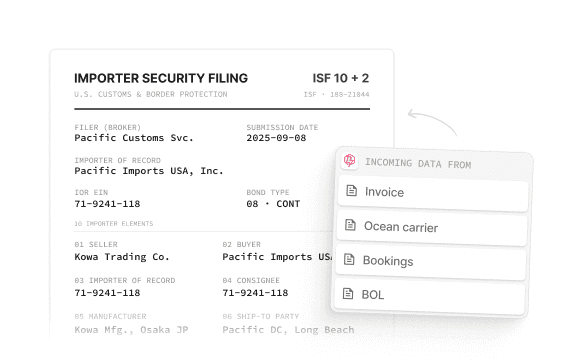
Every entry generates a trail of commercial invoices, packing lists, certificates of origin, HTS classifications, and compliance checks. That trail is still processed by hand. Docxster is a no-code document automation platform that turns customs documents into validated, classified, and entry-ready data.
problem 1
Document chaos from unstructured inbound
Every shipment arrives differently — PDF invoices, scanned packing lists, emailed certificates, fax-to-email BOLs. Your team spends the first 20 minutes of every entry just organizing the paperwork before they can do any actual work.
problem 2
Manual keying is where errors enter the system
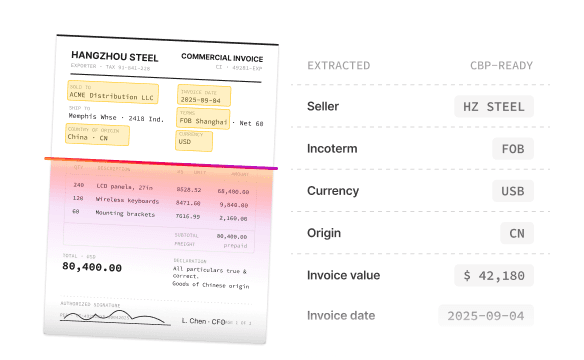
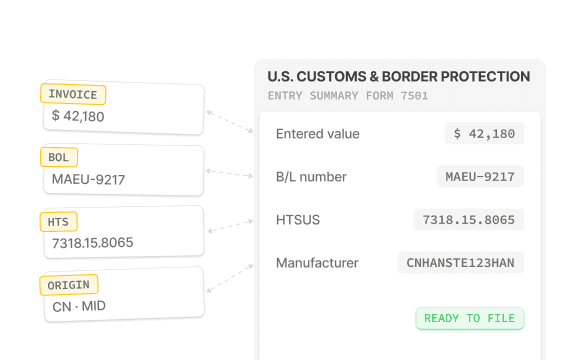
Every field typed by hand is a field that can be wrong. Importer name, HTS code, declared value, country of origin — each one re-entered from a document that already has it. The error doesn't show up until CBP flags it, and by then it's a delay or a penalty.
problem 3
Vague commercial descriptions send you back to the importer every time
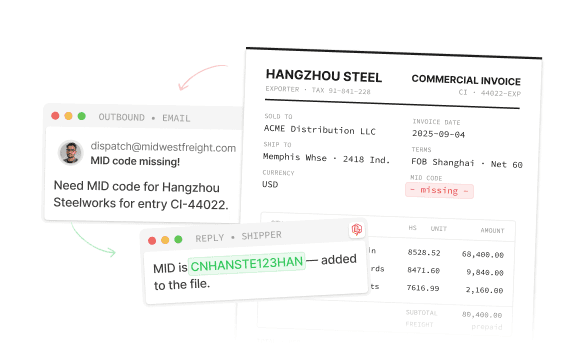
"General merchandise." "Machine parts." "Household goods." Descriptions that tell you nothing useful force your entry writers to chase the importer for clarification — adding hours or days to every affected shipment while the cargo sits.
problem 4
HTS classification is judgment work being done under time pressure
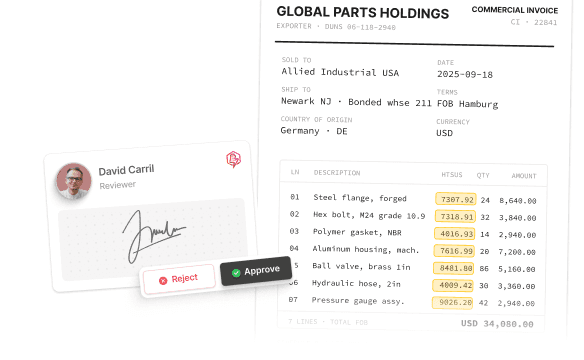
Getting the classification right requires reading the description, cross-referencing the schedule, checking binding rulings, and making a defensible call — all before the entry deadline. When you're processing hundreds of entries a month, the pressure to move fast is exactly when misclassifications happen.
problem 5
Compliance checklists are only as good as the person holding them
Required fields, valuation thresholds, country-of-origin rules, PGA flags — your team is mentally checking boxes against every entry. One distracted afternoon, one new hire, one unusually complex shipment, and something gets missed. A checklist in someone's head is not an audit trail.
problem 6
Entry backlogs compound when volume spikes
Peak season, a major customer's import surge, or simply a good quarter — and suddenly the queue is longer than the team can clear. Entries get rushed. Review gets lighter. The work that most needs careful attention is the work getting the least of it.
Built for the people who clear shipments and stake their license on every entry
VP Supply Chain Operations
Manages document flows across dozens of carriers, each with their own format. A single shipment generates documentation from the shipper, the carrier, customs, and the consignee.
Customs Broker Manager
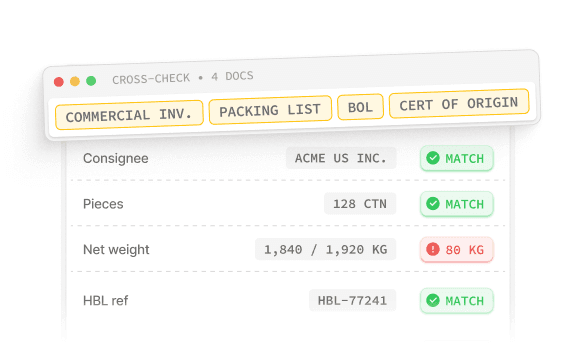
Incoming dockets need to be classified by document type, data needs to be keyed into the brokerage system, and every entry needs to be eyeballed for discrepancies.
Corporate Controller
Month-end close depends on carrier invoices being reconciled — but invoices arrive in waves, in different formats, with disputed accessorial charges.
Operations Lead
Coordinates the handoff between carrier documentation, TMS entry, and customer billing. When a document is stuck, the whole chain stalls.
VP Supply Chain Operations
Manages document flows across dozens of carriers, each with their own format. A single shipment generates documentation from the shipper, the carrier, customs, and the consignee.
Customs Broker Manager
Incoming dockets need to be classified by document type, data needs to be keyed into the brokerage system, and every entry needs to be eyeballed for discrepancies.
Corporate Controller
Month-end close depends on carrier invoices being reconciled — but invoices arrive in waves, in different formats, with disputed accessorial charges.
Operations Lead
Coordinates the handoff between carrier documentation, TMS entry, and customer billing. When a document is stuck, the whole chain stalls.
Connects to the tools customs teams already use
Email & Document Intake


Accounting & Finance


Customs Brokers Softwares


CRM & Sales


Productivity & Collaboration


Data & Storage


Communication & Notifications


AI & Processing


