-
5 Signs You're Scaling Customs with Headcount, Not Process
Identify 5 signals your brokerage is scaling through headcount instead of customs declaration automation — plus what each pattern costs per entry processed.
Last updated:
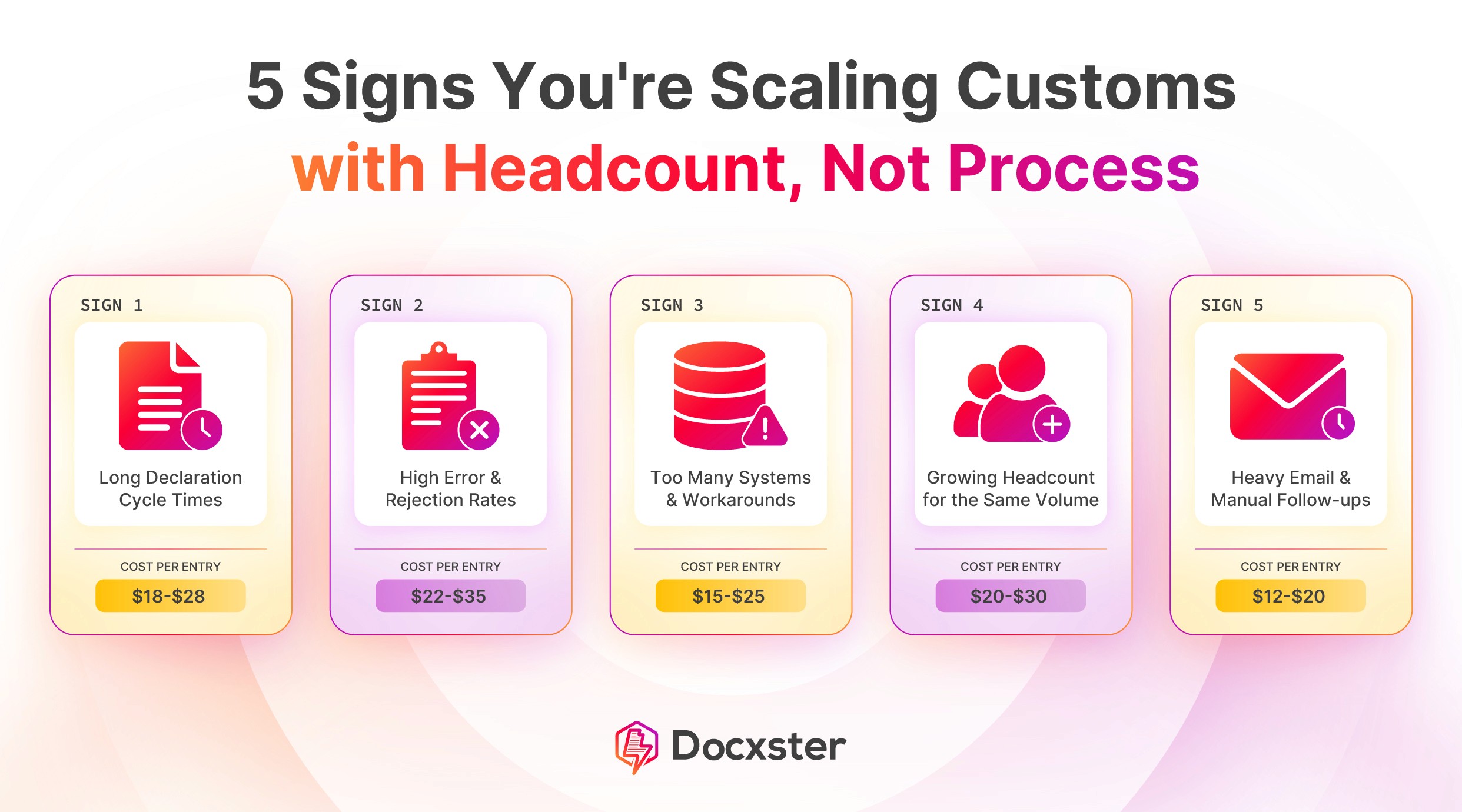


A diagnostic framework for spotting when manual throughput becomes a structural cost — and what each signal costs per entry
Learn to identify five operational signals that your customs brokerage is absorbing volume through staffing rather than process improvement. Each signal includes a per-entry cost breakdown to quantify the margin impact of delaying customs declaration automation.
TL;DR
Headcount-driven scaling is a margin trap - When every new shipment requires a human to read, key, and validate, your costs scale linearly with volume while your revenue per entry stays flat or compresses.
Five diagnostic signals reveal the problem - Volume-correlated error spikes, long onboarding ramps, peak-staffing overhead, senior staff doing data entry, and rising per-entry costs all point to manual throughput as a structural cost.
Automation changes the cost curve, not the team - Automated customs filings process 4.3x faster and can reduce error rates by up to 67%. The goal is freeing skilled staff for compliance work, not eliminating roles.
Start with the extraction layer - Document intake and data extraction is where manual labor concentrates most. Solving this bottleneck first delivers the fastest payback for brokerages handling 500+ monthly entries.
Measure before you invest - Track your error rate by volume period and your per-entry cost monthly. These two metrics will tell you within 30 days whether your operation has a process problem or just a busy season.
The Hidden Cost Curve: When More Shipments Just Means More People
Most customs brokerages don't decide to scale through headcount. It happens gradually. A new client adds 80 entries per month, so you hire a part-time clerk. Tariff schedules shift, so you bring on a compliance specialist. Before long, your customs declaration automation strategy is just… more desks.
The math feels sustainable until it isn't. Labor costs in customs brokerage are largely fixed: salaries, benefits, training, turnover. But shipment volume is variable, seasonal, and increasingly unpredictable. When your throughput depends on how many people you can seat in a room, every volume spike becomes a staffing crisis and every lull becomes an overhead problem.
This isn't a pitch for replacing people with software. It's a diagnostic. Below are five operational signals that indicate your brokerage has crossed the line from "busy" to "structurally inefficient," along with what each pattern actually costs per entry.
Who This Is For (and What It Doesn't Cover)
This guide is built for customs compliance managers and brokerage operators processing 500 or more shipments per month. If you're running a team of 5 to 25 entry specialists and feel the tension between volume growth and margin compression, these signals will be familiar.
What this list does not cover: enterprise-scale customs platforms requiring six-figure implementations, government policy analysis, or country-specific regulatory guidance. The focus here is operational diagnosis. Identifying where manual throughput has become a structural cost rather than a temporary workflow gap.
How These Signals Were Selected
Each signal below was selected based on three criteria: it appears consistently across mid-market brokerages handling 500 to 20,000 monthly entries, it has a measurable per-entry cost impact, and it responds to process redesign (not just technology adoption). The goal is pattern recognition, not a product comparison.
5 Signals Your Customs Operation Is Scaling Through Headcount
1. Your Error Rate Climbs With Volume, Not Complexity
Why it matters: A rising error rate during high-volume periods reveals a capacity problem, not a competence one. When experienced staff make more mistakes simply because they're handling more entries, the process itself is the bottleneck. Each rejected or corrected filing carries direct costs: penalty exposure, re-filing labor, and delayed clearance that cascades through the supply chain.
"Yeah, let me put that at about 15% — errors that come back from customs."
Operations lead at a customs brokerage processing 8,000–10,000 entries per month, with over 30 entry writers on staff.
What it looks like today: Operations that have introduced automated customs filings report reductions to roughly 2%, a 67% drop. That gap, multiplied across hundreds of monthly entries, translates directly into rework hours and compliance risk.
How to apply it: Track your error rate as a function of volume, not just as a flat percentage. If errors spike above your baseline during peak weeks, your team isn't failing. Your process is absorbing volume through human attention, which doesn't scale. Start by identifying the three entry fields that generate the most corrections, then evaluate whether extraction or validation at those points can be automated.
2. New Hires Take 90+ Days to Reach Full Entry Throughput
Why it matters: Long ramp-up times are a hidden multiplier on your cost-per-entry. If every new hire spends three months at partial productivity, you're paying full salary for fractional output. For a brokerage adding two to three people per year, that's the equivalent of six months of underutilized labor annually. The cost isn't just the salary. It's the senior staff pulled into training instead of processing. According to CGS Immersive, onboarding a licensed customs broker runs roughly 40 hours of specialized training — an internal cost of around $3,400 per hire before they process a single entry.
What it looks like today: Manual customs entry requires familiarity with HS code classification, document interpretation across inconsistent formats (commercial invoices, packing lists, bills of lading), and broker-specific workflow conventions. Each of these creates a knowledge dependency that extends onboarding. Operations using intelligent document processing and templated workflows reduce the cognitive load on new hires by standardizing extraction and validation before human review.
How to apply it: Measure time-to-full-throughput for your last three hires. If it exceeds 60 days, examine which tasks consume the most training time. Often, it's not regulatory knowledge but document interpretation: reading inconsistent supplier formats, locating key fields, and cross-referencing across multiple documents. These are extraction problems, not expertise problems, and they respond well to automation.
3. You Staff for Peak Volume but Pay for Trough Volume
Why it matters: Seasonal and client-driven volume swings are a defining feature of customs brokerage. But if your staffing model is built around peak capacity, you're carrying excess labor cost during every off-peak period. The structural problem is that human throughput doesn't flex down. You can't run half a person during a slow month.
"We print that document out, there's a traffic executive that will literally open up a traffic file and then start entering per line item."
Licensed Customs broker, Mexico border operations, describing in-bond document processing.
What it looks like today: That speed differential means automated workflows can absorb volume spikes without requiring proportional staff increases. The economic argument isn't about eliminating roles. It's about decoupling your throughput ceiling from your headcount.
How to apply it: Calculate your cost-per-entry at peak volume and at trough volume. If the gap exceeds 30%, your operation is paying a significant premium for capacity it uses intermittently. Identify the entry types with the most predictable document formats (these are your automation candidates) and pilot automated document workflows on those first. Redirect staff capacity toward exceptions and complex classifications where human judgment adds real value.
4. Senior Staff Spend More Time on Data Entry Than Compliance Review
Why it matters: When your most experienced (and expensive) team members are manually keying data from commercial invoices into your customs management system, you're misallocating your highest-value resource. Senior staff exist for HS code validation, regulatory interpretation, and audit readiness. Every hour they spend on data transcription is an hour not spent on the work that actually protects your license and your clients.
A licensed customs broker specializing in post-entry work — protests, prior disclosures, CF-28 responses, drawback — described her daily reality: "In our current systems, I have to manually key in data and then download it in order to look at it. And then we're sitting here changing statuses so we know who worked on it — they have to go in and remember to change the status. All of that is just very clunky." This is someone whose expertise is worth hundreds of dollars an hour in compliance value. She's spending part of every day navigating a broken folder structure.
What it looks like today: Many mid-market brokerages still rely on manual re-keying from PDFs, emails, and scanned documents. Tools like Docxster use templateless extraction to pull data from trade documents (invoices, packing lists, purchase orders) without requiring pre-configured templates for each supplier format. For brokerages dealing with dozens of client document layouts, this eliminates the bottleneck of format-specific setup while freeing senior staff to focus on compliance-critical review.
How to apply it: Audit how your senior team spends a typical week. If more than 40% of their time involves data transcription or document reformatting, you have a misallocation problem. Separate the extraction step (pulling data from documents) from the compliance step (validating classifications and values). Automate the first. Protect the second.
5. Your Per-Entry Cost Rises Faster Than Your Revenue Per Entry
Why it matters: This is the summary signal. If your cost-per-entry is increasing while your fee structure stays flat or compresses (as it does in competitive brokerage markets), you are on a margin trajectory that volume alone cannot fix. Adding more entries at a loss doesn't build a business. It accelerates a problem.
What it looks like today: The customs technology market is growing rapidly, with AI and machine learning integration expanding at a 15.3% CAGR. Yet 25% of customs professionals have not yet started AI adoption, and 39% are still in pilot stages. This means the cost advantage of automation is available but unevenly distributed. Early movers in the SMB brokerage space are quietly building per-entry cost structures that late adopters will struggle to match.
"I've got 10 people on computers working on 4, 5, 6, 600-line items. It takes 2–3 days sometimes. If you have 800 lines and the breakdown goes into two different lines, you have 1,600-line reports. You get it done in six hours, transmit, get a kickback for errors, then you have to do everything all over again — that's another four hours. It's a two-day process." — Director of Customs Operations at a large Global Manufacturing Company, describing a single high-complexity entry during tariff reclassification.
How to apply it: Build a simple per-entry cost model that includes labor (fully loaded), software, error-related rework, and penalty exposure. Track it monthly. If the trend line is rising, identify which cost components are volume-sensitive (labor, rework) versus fixed (software, compliance infrastructure). Prioritize automation where the variable cost is highest. For most brokerages, that's the document intake and data extraction layer.
The Pattern Beneath the Signals
All five signals share a common root: manual processes that worked at lower volumes have become structural costs at higher volumes. The throughput ceiling isn't your team's skill or effort. It's the architecture of the workflow itself. When every new entry requires a human to read a document, key data into a system, and validate the output, your cost scales linearly with volume. Automation changes the cost curve from linear to logarithmic.
The second-order effect is subtler. Teams trapped in manual throughput loops lose the capacity for the work that actually differentiates a brokerage: compliance strategy, client advisory, audit preparation, and classification accuracy. Error reduction in customs isn't just about avoiding penalties. It's about reclaiming the bandwidth for work that builds client trust and regulatory resilience.
The tradeoff is real: automation requires upfront investment in process redesign, tool evaluation, and change management. But the alternative (hiring your way through every volume increase) compounds cost in a way that erodes margin permanently.
Where to Start: Customs Declaration Automation Priorities
You don't need to address all five signals at once. Start with the one that's most measurable in your operation. For most brokerages, that's Signal 1 (error rate tracking) or Signal 5 (per-entry cost modeling). Both produce data within 30 days that either confirms or challenges your assumptions.
If you're processing 500 to 20,000 entries monthly with a team under 15, focus on the document intake layer first. That's where the highest volume of manual labor concentrates and where OCR technology for customs and templateless extraction tools deliver the fastest payback. Save the complex classification and multi-country customs support challenges for phase two. Solve the extraction bottleneck first, then build from there.
Frequently Asked Questions - Customs Workflow Automation
What is customs document automation?
Customs document automation uses software (often powered by AI, OCR, or intelligent document processing) to extract, validate, and route data from trade documents like commercial invoices, packing lists, and bills of lading. Instead of manually re-keying information into customs management systems, automated workflows pull the relevant fields directly from source documents and populate entry forms. This reduces both processing time and transcription errors.
How does customs document automation reduce errors in filing?
Most customs filing errors originate in manual data transcription: misread values, transposed digits, incorrect HS codes copied from the wrong line item. Automation reduces these errors by extracting data programmatically and applying validation rules before submission. Brokerages using automated customs filings have reported error rate reductions from 6% down to 2%, according to industry research.
When should a company consider implementing customs document automation?
The clearest trigger is when your per-entry cost rises as volume increases, or when error rates spike during busy periods. If you're hiring to keep up with shipment volume rather than to add new capabilities, that's a strong signal. Brokerages processing 500 or more entries per month typically reach the threshold where manual throughput becomes a structural cost rather than a manageable workflow.
Which types of customs documents can be automated?
The most commonly automated documents include commercial invoices, packing lists, bills of lading, certificates of origin, and purchase orders. Documents with relatively consistent data fields (even across varying formats) are the strongest candidates. Templateless extraction tools can handle supplier-specific layouts without requiring pre-configured templates for each document type.
How does intelligent document processing work in customs automation?
Intelligent document processing (IDP) combines OCR (optical character recognition) with AI models that understand document structure and context. Rather than just reading text on a page, IDP identifies which fields contain shipment values, product descriptions, quantities, and classification codes. It then extracts and maps that data to the appropriate fields in your customs entry system, flagging anomalies for human review.
Can small and mid-sized brokerages afford customs automation?
Yes. The market has shifted significantly. Current tools, including no-code platforms designed for SMBs, don't require six-figure implementations or dedicated IT teams. The key is starting with the document intake and extraction layer (where manual labor concentrates most heavily) rather than attempting a full end-to-end platform deployment on day one. Many brokerages see payback within the first quarter by reducing rework hours and reallocating senior staff time.
Turn documents into decisions.
See how Docxster gets you from inbox to insight in minutes, not days. Bring your toughest workflow — we'll show you what it looks like solved.


