-
Customs Automation: Why Deployment Speed Beats Features
Customs automation platforms promise everything but take months to deploy. High-volume brokers need tools that work on day one — here's what actually matters.
Last updated:
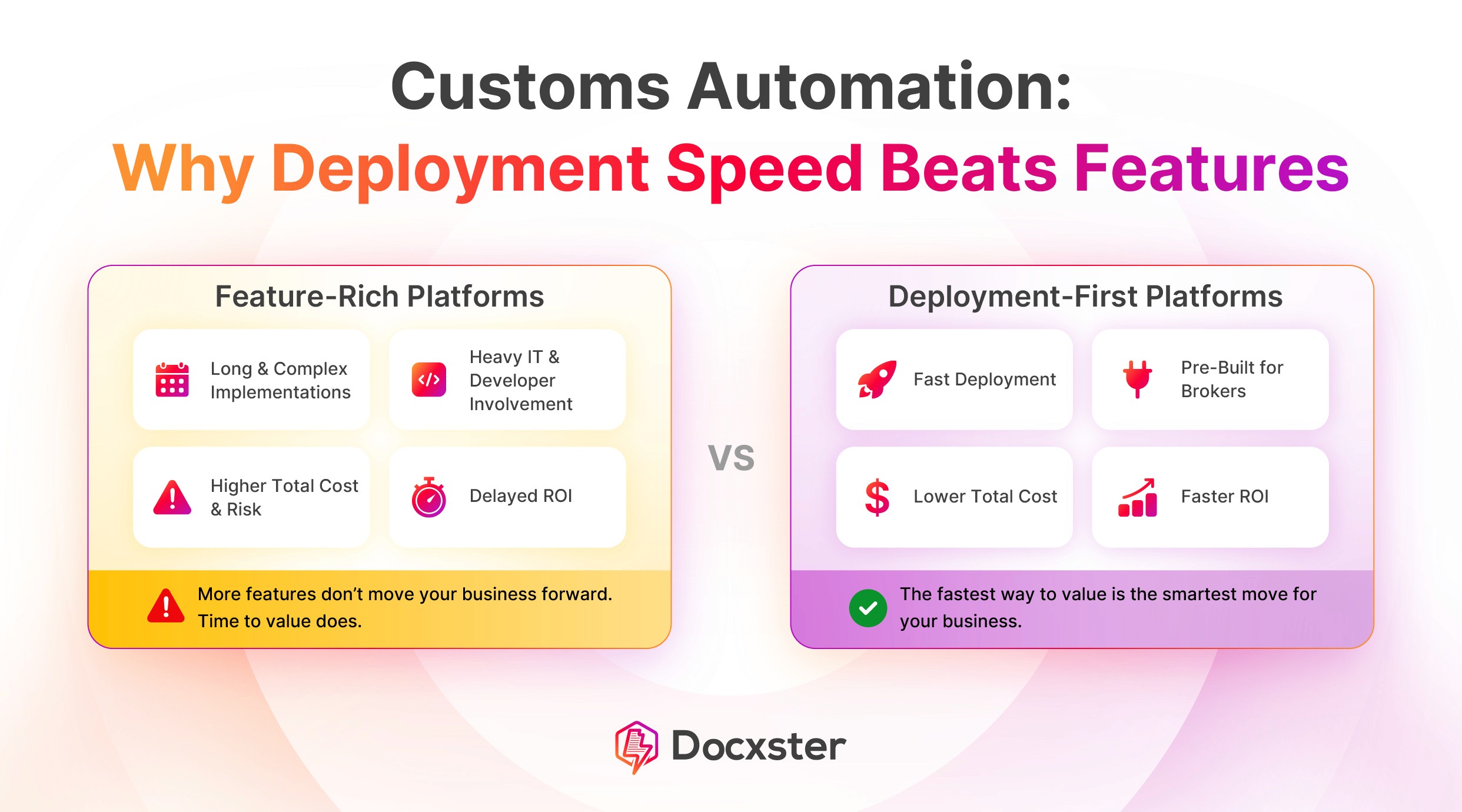


High-volume brokers don't need six-month implementations — they need tools that work on day one, across every document format
Learn why practical deployability matters more than feature depth for customs brokers processing hundreds of shipments monthly. Explores how no-code automation outperforms enterprise platforms for teams without dedicated IT resources.
TL;DR
Document inconsistencies, not complexity, cause most customs clearance delays - Mismatched quantities, weights, and values across multi-party documents (shipper, carrier, broker) are the primary culprit, and they compound at every manual handoff.
Enterprise customs automation platforms aren't built for mid-sized brokers - Long implementation timelines, rigid template requirements, and high costs leave the brokers who need automation most without practical options.
Deployability matters more than feature depth - The relevant benchmark for high-volume brokers without IT teams is whether a tool works on day one across every document format they receive, not how many integrations it supports.
Fix intake, not just integration - The real bottleneck is validating document consistency at the moment documents arrive, before they enter any system or reach any customs authority.
The Shipment Cleared. The Documents Didn't.
Every customs broker has lived this moment. The cargo is at port, the carrier is waiting, and somewhere between the commercial invoice and the packing list, a weight discrepancy holds everything up. Not a fraud issue. Not a tariff dispute. Just a number that doesn't match across two documents from two different parties. This is the reality of customs clearance delays in high-volume brokerage: they rarely stem from complexity. They stem from inconsistency. And for brokers processing 500+ shipments a month without dedicated IT teams, customs automation has become less of a nice-to-have and more of a survival question.
The Enterprise Automation Promise (and Its Fine Print)
The industry's answer to document inconsistencies has been predictable: invest in a large-scale customs automation platform. These systems promise end-to-end digital documentation, automated HS classification, and seamless integration with national customs portals. On paper, they're impressive.
And for the top-tier freight forwarders with six-figure IT budgets and months to spare for implementation, they deliver. The problem is that most customs brokerages aren't those companies. They're 10-to-50-person operations juggling documents from dozens of shippers, each with their own formats, their own quirks, their own version of a commercial invoice. The enterprise platforms were built for standardized, high-control environments. The real brokerage floor is anything but.
So what happens? Brokers evaluate these platforms, get sticker shock on the implementation timeline and associated costs, and go back to spreadsheets and manual cross-checking. The gap between what's available and what's deployable keeps widening. In fact, 25% of freight forwarders and customs brokers identify manual workflows as their single biggest barrier to growth, per Descartes' 2025 Benchmark Study.
The Real Benchmark Isn't Feature Depth. It's Day-One Deployability.
Here's what we actually believe: the most important measure of customs automation for mid-sized brokers isn't how many features a platform has. It's whether a compliance manager can feed it a document on Monday and trust the output by Tuesday. Deployability is the new feature.
Where Customs Automation Fails the Brokers Who Need It Most
Let's trace the anatomy of a typical customs clearance delay caused by document inconsistency. A shipper in Shenzhen sends a commercial invoice listing 4,200 units at $3.10 each. The packing list from the same shipper says 4,020 units. The bill of lading, issued by the carrier, references a gross weight that doesn't align with either document. Three parties, three documents, three versions of the truth.
A compliance manager catches the discrepancy, but not until the shipment is already flagged at the border. Now it's a race: contact the shipper, get a corrected invoice, resubmit the declaration, and hope the port authority doesn't impose a secondary inspection. Multiply this by a few dozen shipments a week and the operational drag becomes enormous.
This isn't hypothetical. Automated customs declarations are processed 4.3x faster on average than manual ones, which means the gap between brokers who catch inconsistencies before submission and those who don't is measured in days, not hours. And the financial stakes are real: in 2023, EU national customs authorities adjusted over €431 million in unpaid customs duties, much of it traceable to documentation errors and non-compliance rather than deliberate evasion.
The pattern we see repeatedly is that the pain point isn't a single document. It's the handoff between documents from multiple parties. Shipper to broker. Broker to carrier. Carrier to customs authority. Each handoff is a chance for a number to shift, a field to go missing, a format to change. Enterprise platforms handle this by enforcing standardized inputs. But mid-sized brokers don't control their shippers' document formats. They receive what they receive.
This is where templateless extraction changes the equation. Instead of requiring every shipper to conform to a specific format (good luck), platforms like Docxster extract data from whatever document format arrives, then validate it against the other documents in the shipment file. No custom templates to build per shipper. No six-month onboarding. A compliance manager can point the system at a stack of mixed-format invoices, packing lists, and bills of lading, and get flagged inconsistencies before the declaration is ever submitted.
That's not a feature comparison. That's a fundamentally different approach to how document processing works in logistics.
Consider the math. With global trade hitting a record $33 trillion in 2024, up 3.7% from the prior year, the volume of cross-border documents flowing through mid-sized brokerages is only increasing. The brokers who can validate documents at intake, before they reach customs, will clear faster, pay fewer penalties, and retain more clients. The ones still relying on manual cross-referencing will keep bleeding time and money at the border.
"By nature, most humans don't like to read, so they'll send whatever they have in front of them associated with a particular shipment, and we need to make sure that we're working with the right documents." — Victor C, Customs Broker
What Changes If Speed-to-Value Wins
If deployability becomes the real benchmark for international shipping automation, several things shift. First, the buying decision moves from IT departments to operations teams. Compliance managers start evaluating tools based on "can I use this today" rather than "can our developer configure this in Q3." Second, the competitive advantage for brokerages stops being about who has the most sophisticated system and starts being about who catches document inconsistencies earliest in the workflow.
Third, and this matters for the industry: the brokers most vulnerable to customs clearance delays are the ones least equipped to adopt the solutions currently marketed to them. That's not a technology problem. It's an accessibility problem. And it means the cost of inaction falls disproportionately on the small and mid-sized firms that handle a significant share of global trade documentation. The firms that can adopt automated document processing across their logistics workflows without a dedicated engineering team will pull ahead quietly and decisively.
“Its kind of hard to take time off, especially everything since last year. I just can't” - Carlos V, Laredo based Customs Broker
A New Lens: Think Intake, Not Integration
Here's the reframe we keep coming back to: most brokers think their automation problem is an integration problem. How do we connect our system to customs portals, carrier platforms, shipper ERPs? But integration assumes you already have clean, consistent data. You don't. Your problem starts earlier.
"I kept getting documents that were not complete. Is the commercial invoice even here?" - Shannon B, Post Entry Brokerage Corrections
The real bottleneck in customs clearance isn't submission. It's intake.
If you can validate document consistency at the moment documents arrive, before they enter any system, you eliminate the single largest source of clearance delays. Integration matters, but it's a second-order problem. Intake is where the errors are born, and intake is where they should die. The brokers who internalize this distinction will stop chasing enterprise integration roadmaps and start solving the problem that's actually costing them money every week.
The Documents Will Keep Coming. The Question Is Whether You Read Them First.
Global trade volume isn't slowing down. Document formats aren't getting more standardized. And customs authorities aren't getting more lenient. The brokers who thrive won't be the ones with the most features on their platform comparison spreadsheet. They'll be the ones whose compliance teams stopped finding discrepancies at the border and started finding them at their desks. That's not a technology upgrade. That's an operational identity shift. And it starts with a simple question: are you automating your documents, or are you still just processing them?
Frequently Asked Questions
What types of documents are commonly required for cross-border shipments?
The core set typically includes commercial invoices, packing lists, bills of lading (or airway bills), certificates of origin, and customs declarations. The specific requirements vary by country, commodity, and trade agreement, which is exactly why inconsistencies across these documents are so common and so costly.
How does automated data validation reduce customs clearance delays?
Automated validation cross-references key fields (quantities, weights, values, HS codes) across all documents in a shipment file before submission. By catching mismatches at intake rather than at the border, brokers avoid the back-and-forth corrections that cause the majority of clearance holdups.
Can small and mid-sized customs brokers realistically adopt customs declaration automation without IT teams?
Yes, if the platform doesn't require custom template configuration or lengthy integration projects. No-code tools with templateless extraction capabilities are specifically designed for teams that need to process diverse document formats from day one without developer support.
How soon can I realistically get started with customs entry automation?
Depending on the complexity of your process, size of your databases and nature of business, you can get started from as early as a week to up to 4 weeks
Turn documents into decisions.
See how Docxster gets you from inbox to insight in minutes, not days. Bring your toughest workflow — we'll show you what it looks like solved.


