Duty Drawback
Definition
Duty drawback is a U.S. customs program that lets a business get back most of the duties, taxes, and fees it paid when it imported goods, generally 99%, once those goods are exported or destroyed instead of sold inside the United States. Drawback is authorized under 19 U.S.C. § 1313.
The order of events matters here. The company pays the full duty first, at the time of import, and only afterward, once the qualifying merchandise leaves the country or gets destroyed, can it file a claim to get most of that money back. Drawback is a refund you apply for after the fact, not a discount you get up front.
What it contains
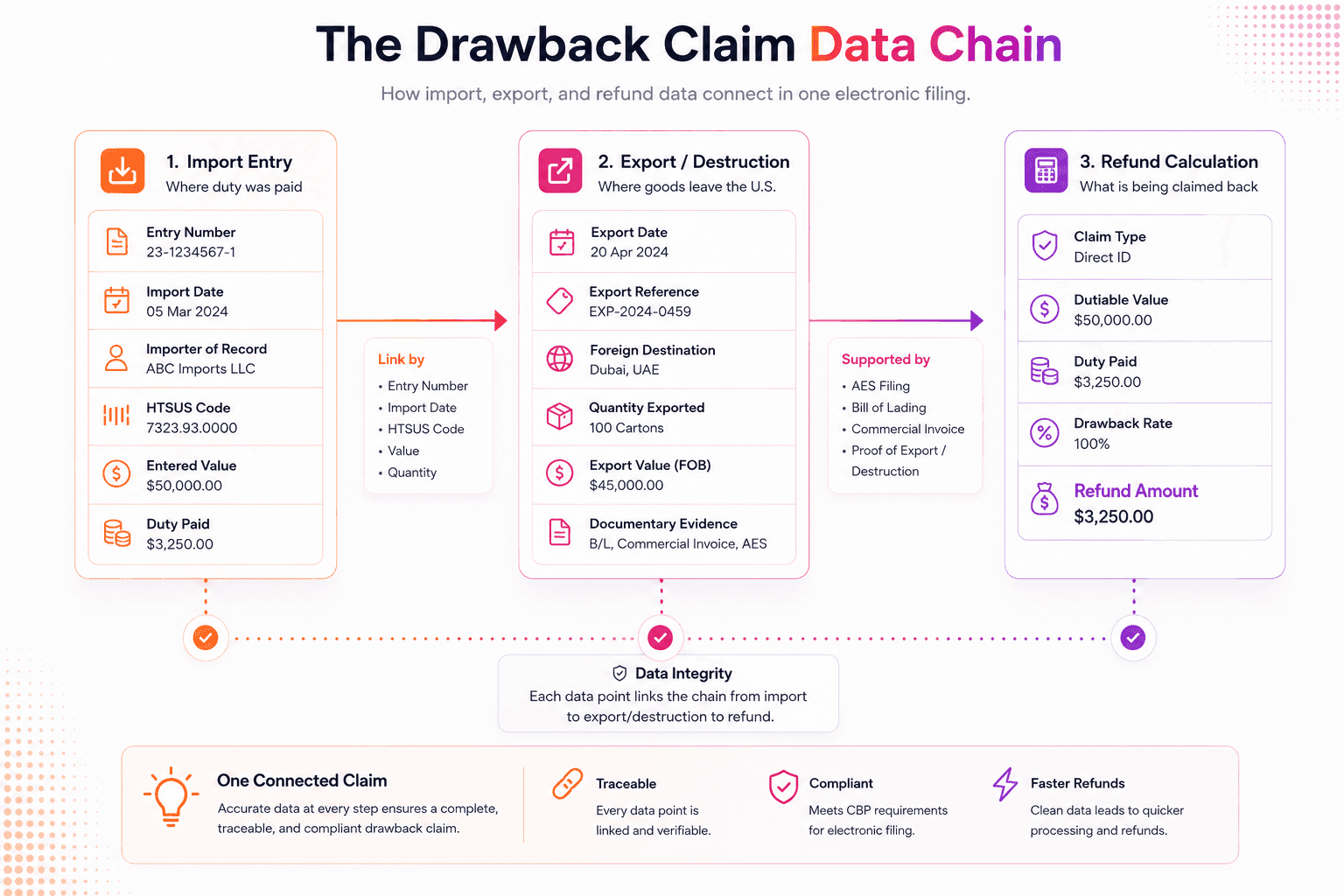
A drawback claim used to mean filling out a paper form. Today it is a set of electronic data filed through CBP's Automated Commercial Environment, known as ACE, and it works more like a case file than a form, connecting several pieces of evidence into one story.
It needs the claimant's ID number, the legal provision the claim is based on, and the 10-digit HTSUS classification code and duty amount from the original import. It also needs proof of what happened next, whether that is evidence the goods were exported or destroyed, plus production records if the goods were turned into something else first.
On top of that, most claims require certifications, declarations, and supporting records transmitted or maintained as required under the applicable drawback provision. For unused-merchandise drawbacks, for example, this includes certifying that the goods were never actually used in the United States, backed up by real records rather than a bare statement.
Where it's used
Duty drawback comes up anywhere a company imports goods, pays duty, and later sends them (or something built from them) back out of the country. A manufacturer might import raw materials, build a finished product, and export it. A distributor might import more inventory than it sells domestically and export the extra. A retailer might get goods back from a customer and export them instead of restocking for U.S. sale. Narrower, specialized versions of drawback also exist for petroleum refining, wine, and aerospace.
Inside a company, this work rarely sits with one person. Import compliance staff handle the entry details and HTSUS codes, export and logistics staff gather proof the goods actually left the country, and finance calculates the refund owed. The claim itself can be filed a few different ways: a company with its own ABI capability can self-file, it can use a licensed customs broker to prepare and transmit the claim, or it can prepare the claim and route it through an authorized service provider.
How it's used
The process runs in a fixed order.
Import and hold onto the records
The company imports goods, pays duty, and holds onto the import records it will need later, like the entry number and HTSUS code. What ultimately gets exported or destroyed to trigger the refund is not always the exact same item that came in. It can be the imported goods themselves, a qualifying substitute for them, or an article manufactured from them, depending on which drawback provision applies.
Give CBP prior notice, if required
For certain unused-merchandise and rejected-merchandise claims, the company generally has to give CBP prior notice before the goods are exported or destroyed, using CBP Form 7553, so CBP has the chance to examine them first. This step can be skipped only if the claimant has an approved waiver of prior notice on file.
Connect the export or destruction back to the import
Once qualifying merchandise is exported or destroyed, the company identifies the designated imported merchandise using an acceptable identification method. This can mean tying the claim to the specific imported goods, or, where the rules allow it, designating other qualifying merchandise under the substitution rules instead.
Calculate the refund
The company works out the refund owed, generally 99% of the eligible duty.
File the claim electronically
The complete claim gets transmitted through ACE using the Automated Broker Interface, whether the filer is the company itself, a licensed broker, or a service provider. The old paper Form 7551 is no longer used to file the claim.
Meet the five-year deadline
This is the part that trips companies up: the entire claim has to be fully submitted within five years of the original import date, or it is treated as abandoned no matter how strong the case was.
CBP reviews and pays out
CBP reviews the claim and pays out at liquidation. Companies that have been granted accelerated-payment privileges can receive an estimated drawback payment earlier, before liquidation, generally against a bond. That early payment is provisional, and CBP can demand repayment if the final liquidated amount turns out to be lower.
In practice, the hardest part is not the customs law itself. It is matching records that live in different places: an import entry in one system, an export record in another, and sometimes a production record in a third.
Example
Picture a U.S. distributor that imports a container of industrial valves and pays duty on the whole shipment. Later, it exports part of that inventory to a customer overseas without ever using those valves inside the United States.
If the company identifies the specific imported valves that were exported, that is direct-identification unused-merchandise drawback.
If it exports different, qualifying valves from the same batch or a later shipment instead, that is substitution unused-merchandise drawback. The general rule for this type of claim is that the imported and substituted valves must fall under the same 8-digit HTSUS subheading.
There is one important exception. If the applicable 8-digit HTSUS description begins with the word "Other," the imported and substituted valves must instead match under the same 10-digit HTSUS statistical reporting number, and that 10-digit description must not itself begin with "Other." Other drawback provisions have their own substitution standards, which are not necessarily identical to this one.
Types
There are three main categories of duty drawback, each fitting a different situation.
Manufacturing drawback
This type covers goods that get transformed before they leave the country. A company imports raw material, uses it in the U.S. to build a finished article, and then exports or destroys that article. It is the category manufacturers rely on, since the connection being proven is between an ingredient or component and the product it becomes. A furniture maker that imports hardwood and exports finished chairs is a manufacturing drawback situation, and the claim has to trace how much of the imported wood ended up in the exported chairs.
Unused-merchandise drawback
This type covers goods that never actually got used inside the United States before they left again. No manufacturing happens in between: the goods go into a warehouse and come back out largely as they were. It is the category a distributor or retailer typically relies on, since inventory usually sits and gets reshuffled rather than getting built into something new. Proving the merchandise was genuinely unused matters more here than in any other type, which is why the certification on the claim carries real weight. A wholesaler that imports more units than it can sell domestically and exports the surplus, still sealed in original packaging, is a straightforward example.
Rejected-merchandise drawback
This type covers several distinct situations, not just goods that arrived damaged or wrong. It includes merchandise that was defective at the time it was imported, merchandise that does not conform to the sample or specification it was ordered against, merchandise that was shipped without the consignee's consent, and qualifying retail merchandise that a customer returned and the importer accepted back under the statutory rules. Finance and returns-processing teams are usually the ones who deal with this type, since it starts with a transaction going wrong rather than a planned export. That last category matters because a returned retail item is not necessarily defective or nonconforming. A customer might simply change their mind, and the return can still qualify under this type of drawback.
Beyond these three, narrower categories exist for specific industries, including finished petroleum derivatives, certain packaging materials, wine, and equipment for qualifying vessels and aircraft, each with its own extra conditions.
Variations
Direct identification vs. substitution
These are two different ways of identifying the merchandise behind a claim. Direct identification ties the exported or destroyed merchandise back to the specific imported merchandise, using an identification method CBP accepts, which does not always require tracking one exact serialized unit. Substitution instead allows qualifying other merchandise to be designated in its place, under whatever substitution rules apply to that particular drawback provision. Companies with large, interchangeable inventory tend to rely on substitution, since tracing one exact physical unit through a warehouse is often impractical, while substitution comes with its own classification requirements to prevent abuse.
Exportation vs. destruction
A claim can be completed on the back end in one of two ways. Export needs evidence the goods physically left the country, such as shipping and customs records at the destination. Destruction needs evidence of when and how the goods were destroyed, usually carried out under CBP supervision so the agency can confirm it happened. A company disposing of obsolete or unsellable imported stock domestically would use the destruction route instead of trying to find a buyer overseas.
Standard payment vs. accelerated payment
This distinction is about timing: when the company actually gets its money. Under standard payment, CBP pays the refund at liquidation, once its full review of the claim is complete, which can take time. Accelerated payment is only available to companies CBP has granted accelerated-payment privileges to, generally subject to a bond requirement, and it means receiving an estimated drawback payment before liquidation happens. Companies that file drawback claims often and need the cash flow sooner are the ones that typically apply for accelerated-payment privileges. That early payment stays provisional until liquidation, and CBP can demand it back if the final amount comes in lower.
FAQs
Is duty drawback the same as a duty exemption?
No. The difference comes down to timing. An exemption means duty is never charged at all. Drawback means the full duty gets paid at import, then most of it, generally 99%, gets refunded once the qualifying goods are exported or destroyed and a claim is approved.
Who can file a duty drawback claim?
It depends on the specific provision, but the claimant is typically the importer, the exporter, or whoever destroys the goods. The party normally entitled to the refund can often hand that right to someone else in the chain, as long as possession and documentation rules are met.
How long do you have to file a drawback claim?
The full claim must be transmitted electronically within five years of the date the goods were originally imported, not five years from export. A claim still incomplete once that window closes is generally treated as abandoned, with a narrow exception for presidentially declared disasters.
Can you still file a paper drawback claim using CBP Form 7551?
No. Since February 24, 2019, every drawback claim has had to be filed electronically through CBP's Automated Commercial Environment, using the Automated Broker Interface, and CBP Form 7551 is no longer used to file it. A separate form, CBP Form 7553, is still relevant today, but for a different purpose: giving CBP prior notice before certain goods are exported or destroyed, not for filing the claim itself.
What happens if a drawback claim turns out to have errors?
The company that filed it is on the hook for the full refunded amount, and CBP can review supporting records for years afterward. Errors caused by carelessness or fraud can bring civil penalties on top of repayment, as high as three times the revenue loss in fraud cases.
Turn documents into decisions.
See how Docxster gets you from inbox to insight in minutes, not days. Bring your toughest workflow — we'll show you what it looks like solved.


