Validation Platform
Catch extraction errors before they reach downstream systems
Validation Platform lets you write rules that check extracted document data on their own, no person required. A reviewer only gets pulled in when a rule actually fails, and the field that caused the trouble is highlighted right on the page for them. If you've been trusting extraction blindly, or reviewing every document just in case, this takes that off your plate.
How it works
A document gets processed, and your rules run against whatever came out of it. If nothing fails, the workflow keeps going and nobody has to look at it. If something fails, the workflow stops, pings a reviewer, and opens a session showing the original document next to the extracted data, with the field that caused the failure highlighted directly on the page. The reviewer confirms it, overrides it if the rule was wrong, and submits. The workflow picks back up on its own.
Label Validations
Check one extracted value at a time (text, a number, a date) against a condition like equals, greater than, or a tolerance range.
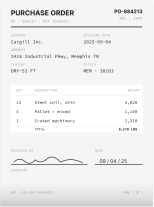
Table Validations
Does the same for table data, checking it row by row against another extracted table or a fixed value you set. Every row has to pass, and the two tables need to line up in row count unless you use a cross-row operator. You can use both action types in the same workflow if a document needs it.
Setup
Your Document Processing step needs its Human Review option set to Support Validation Platform first. Skip that, and the visual review screen won't have the bounding box data it needs, and nothing downstream gets a review session URL to use. Once that's on, add a Label Validations or Table Validations action right after Document Processing and write your rules. An Assignee field lets you put a specific person with validation permissions on the hook for a failure, instead of leaving it for whoever notices first.
Docxster logs every review session, confirmed or overridden: who looked at it, what they decided, and when. That's what makes this an actual checkpoint instead of a vague promise that someone's watching, without making every document wait around because a few needed a second look.

Where this is useful
Freight and logistics operations
Your rate confirmation and carrier invoice should agree on the charges, but they don't always. Set a Label Validation with a tolerance range to catch the mismatch automatically, so you only step in when the numbers are actually off, instead of checking every shipment by hand.
Customs brokerage
An entry filed with the wrong HS code or duty amount carries real compliance risk. Set rules that check those fields against exact values or expected ranges to catch a bad extraction before the entry goes out, with the exact field highlighted on the original document instead of you re-reading the whole thing.
Lending and mortgage
Income figures show up across a pay stub, a loan application, and a verification letter, and they need to match. Use a Table Validation to compare those extracted values directly, so only the loan files with a real discrepancy reach an underwriter, instead of every file getting reviewed line by line.
Manufacturing and procurement
A purchase order's line items need to match what was actually approved: quantities, SKUs, prices. Use Table Validations to check an extracted PO against a reference table automatically, so your procurement team only sees the exceptions that need a decision, not every order that came in clean.
Turn documents into decisions.
See how Docxster gets you from inbox to insight in minutes, not days. Bring your toughest workflow. We'll show you what it looks like solved.


