-
Document Data Extraction: Why Leases Break Every Template-Based Tool
Most document data extraction tools were built for invoices, not leases. Learn why template-based field extraction fails on legal documents and what to look ...
Last updated:
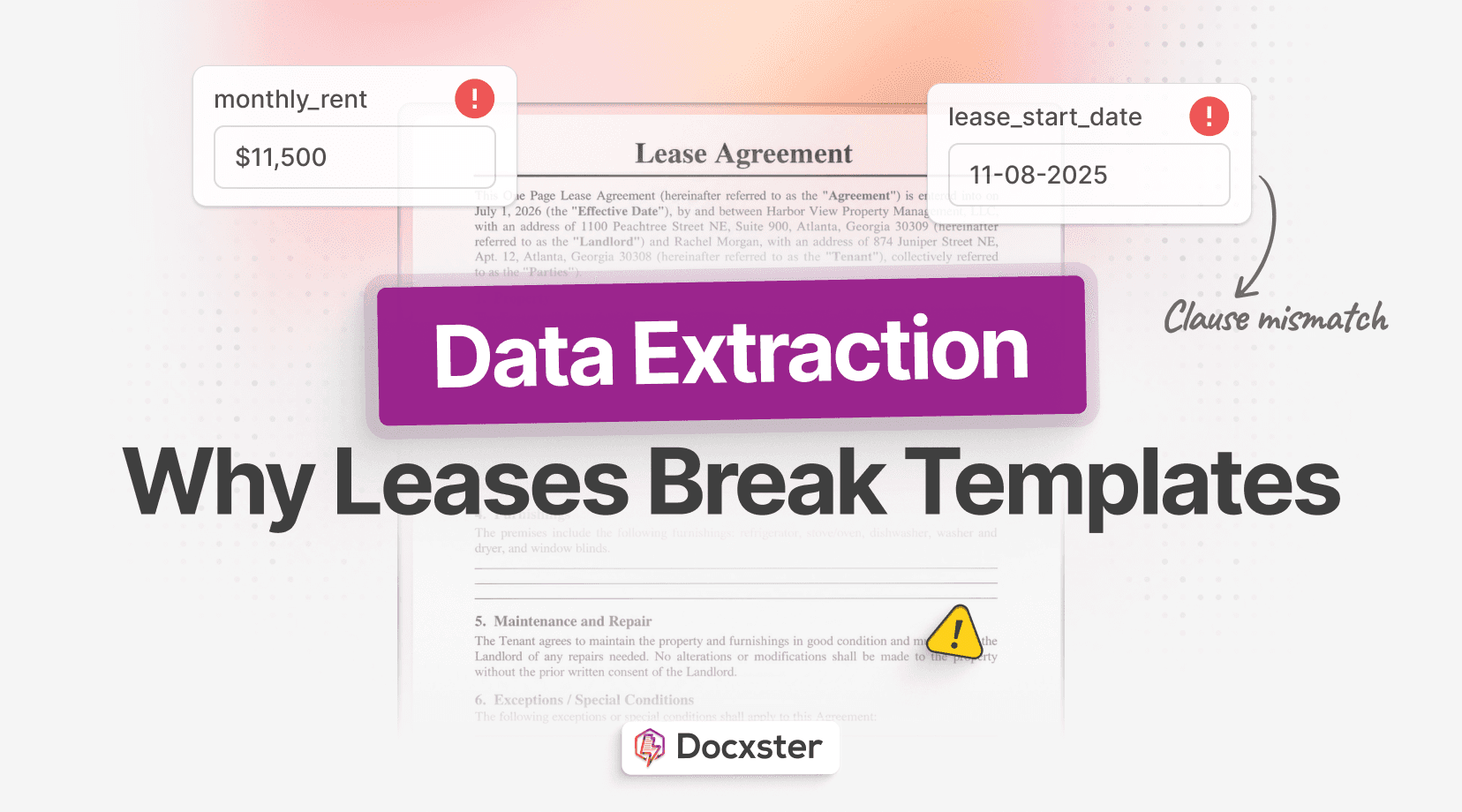

Field extraction methods built for invoices fail the moment a landlord's attorney gets creative with formatting
Learn why most document data extraction tools fail on commercial leases and what CRE operations leaders should evaluate instead. Explores how document layout analysis and adaptive field extraction outperform rigid, template-based approaches.
TL;DR
Leases are not forms - Commercial leases vary dramatically in structure, formatting, and clause placement, which means template-based extraction tools break down at portfolio scale.
Document layout analysis is the differentiator - The ability to understand page structure and clause relationships (not just fixed field positions) determines whether extraction works on the documents you have not seen yet.
Evaluate vendors on worst-case documents - Your extraction system's reliability is defined by how it handles the messiest, most unusual lease in your portfolio, not the cleanest one.
Confidence scoring enables smarter human review - The goal is not replacing lease analysts but directing their attention to genuinely ambiguous clauses instead of re-keying data the system already captured correctly.
Every Lease Looks the Same Until You Try to Extract Data From It
You have seen it happen. A portfolio acquisition closes, 200 lease PDFs land on your team's desk, and someone fires up the extraction tool that worked fine on invoices last quarter. Two days later, your analysts are manually re-keying escalation clauses because the system choked on a landlord attorney's preferred formatting. The problem is not the volume. The problem is that most document data extraction tools were never built for documents that refuse to sit still.
The Template Trap in Lease Administration
It is easy to understand why template-based extraction became the default. For invoices, purchase orders, and standardized forms, it works. You define where a field lives on the page, the system grabs it, and you move on. Vendors built entire product lines around this logic, and for years it was good enough.
The approach became so dominant that when CRE operations teams went looking for document extraction tools, they found products shaped by accounts payable workflows. Fixed zones. Rigid field maps. Predictable layouts. The assumption baked into every product demo: your documents look the same every time.
For lease administration, that assumption breaks on contact with reality.
Lease Abstracts Are Not Invoices
Here is what we actually believe: the biggest failure in lease document extraction is not bad OCR or weak AI. It is the category error of treating legal documents like structured forms.
A commercial lease is a negotiated artifact. Two attorneys shaped it. Jurisdiction influenced it. The property type colored its structure. No two landlords format rent escalation schedules the same way. Some embed options to renew inside a single paragraph of boilerplate. Others break them into numbered exhibits attached 40 pages deep. The variability is not a bug in the document. It is the nature of the document.
Why Field Extraction Methods Fall Apart at Portfolio Scale
Consider what actually happens during a portfolio acquisition. You receive lease files from multiple property managers, each with their own document conventions. Some arrive as scanned TIFFs from a filing cabinet. Others are Word documents exported to PDF. A few are native digital files with embedded tables. An estimated 82% of enterprise data sits trapped in unstructured formats like these, and lease portfolios are a textbook example of the problem.
Template-based extraction assumes the rent commencement date always appears in the same position on page three. But in practice, it might be buried in a definitions section, referenced obliquely in an amendment, or split across a base lease and a side letter. Traditional field extraction methods that depend on predefined coordinates simply cannot follow a clause that moves.
This is where document layout analysis becomes the differentiator most operations leaders overlook when evaluating vendors. Layout analysis does not ask "where is the rent field?" It asks "what is the structural relationship between this heading, this paragraph, and this table?" It reads the architecture of the page, not just the pixels.
The distinction matters enormously. When a system understands layout, it can recognize that a rent schedule formatted as a paragraph in one lease and a table in another are conveying the same information. When a system depends on templates, it sees two completely different documents and fails on one of them.
Current lease abstraction platforms report the ability to extract 200+ data points per lease and reduce processing time by 70% to 90% compared with manual review. But those numbers only hold when the extraction engine can adapt to document variation without requiring someone to build a new template every time a new landlord's format shows up.
This is exactly why template-free extraction has gained traction in CRE. Lease agreements, rent rolls, and inspection reports vary by property manager and jurisdiction, which means extraction systems must adapt rather than depend on rigid templates. Platforms like Docxster were built around this principle of templateless extraction, handling multi-format documents without requiring predefined layouts, an approach that translates directly to the variability CRE teams face at portfolio scale.
There is another practical dimension that rarely comes up in vendor demos: confidence scoring. When an extraction system processes a lease and flags a field with 98% confidence versus 72% confidence, your team knows exactly where to focus human review. This is not about replacing your lease analysts. It is about making sure they spend their time on genuinely ambiguous clauses rather than re-verifying data the system already got right. The best automated data extraction workflows build this human-in-the-loop review into the process by design, not as an afterthought.
What Changes If You Stop Treating Leases Like Forms
If this framing is correct, the implications for how you evaluate extraction vendors shift significantly. The question is no longer "can your tool read a PDF?" Every tool can read a PDF. The question becomes: "What happens when the next batch of leases looks nothing like the last batch?"
For a Director of Lease Administration managing a growing portfolio, this means the difference between a tool that scales with acquisitions and one that creates a new bottleneck with every deal. For a CFO, it means the difference between trusting the numbers that flow into your lease accounting system and maintaining a shadow spreadsheet "just in case."
The cost of getting this wrong is not abstract. It is a missed renewal option. A misread escalation clause. A tenant dispute where your own records contradict the lease because someone keyed the wrong effective date during a manual review marathon.
A Better Way to Think About Document Data Extraction for Leases
Here is the reframe: stop evaluating extraction tools on how well they handle your best-case document. Evaluate them on how they handle your worst-case document.
The scanned amendment from 2004 with a coffee stain on the signature page. The 90-page ground lease with nested exhibits. The sublease where the rent schedule is described in narrative prose rather than a table. Your extraction system's value is determined at the edges, not the center.
Think of it this way: the reliability of your lease data is only as strong as your system's ability to handle the document it has never seen before.
The Documents Will Keep Getting Stranger
Lease portfolios do not get simpler over time. They get more complex. More jurisdictions, more property types, more amendments stacked on amendments. The teams that build their extraction workflows around adaptability rather than rigid templates will not just save time. They will build a data foundation they can actually trust when it matters.
The question is not whether your tool can handle today's leases. It is whether it can handle the ones you have not seen yet.
Frequently Asked Questions
What is document data extraction in the context of lease administration?
Document data extraction for leases means pulling specific data points (rent amounts, key dates, renewal options, escalation terms) from lease PDFs, scans, and Word documents into structured, usable formats. Unlike invoice extraction, lease extraction must handle significant variability in formatting and legal language across documents.
Why do template-based extraction tools struggle with commercial leases?
Template-based tools rely on fields appearing in consistent positions across documents. Commercial leases are negotiated individually, so the same data point (like a rent commencement date) can appear in different locations, formats, and even different attached exhibits from one lease to the next.
How can I improve the accuracy of my lease extraction process?
Prioritize tools that use document layout analysis rather than fixed templates, and look for confidence scoring that routes low-certainty fields to human reviewers. This combination lets your team focus expertise where it matters instead of re-verifying every extracted value.
Turn documents into decisions.
See how Docxster gets you from inbox to insight in minutes, not days. Bring your toughest workflow — we'll show you what it looks like solved.


