ISF Filing (10+2)
Definition
An ISF filing (Importer Security Filing, better known as "10+2") is information a US importer must send to US Customs and Border Protection (CBP) before ocean cargo is loaded onto a ship heading to the United States. The importer provides 10 pieces of data and the ocean carrier provides 2, which is where the name "10+2" comes from.
It has to reach CBP no later than 24 hours before the goods are loaded at the foreign port, and it applies only to cargo arriving by sea, never by air, truck, or rail.
What It Contains
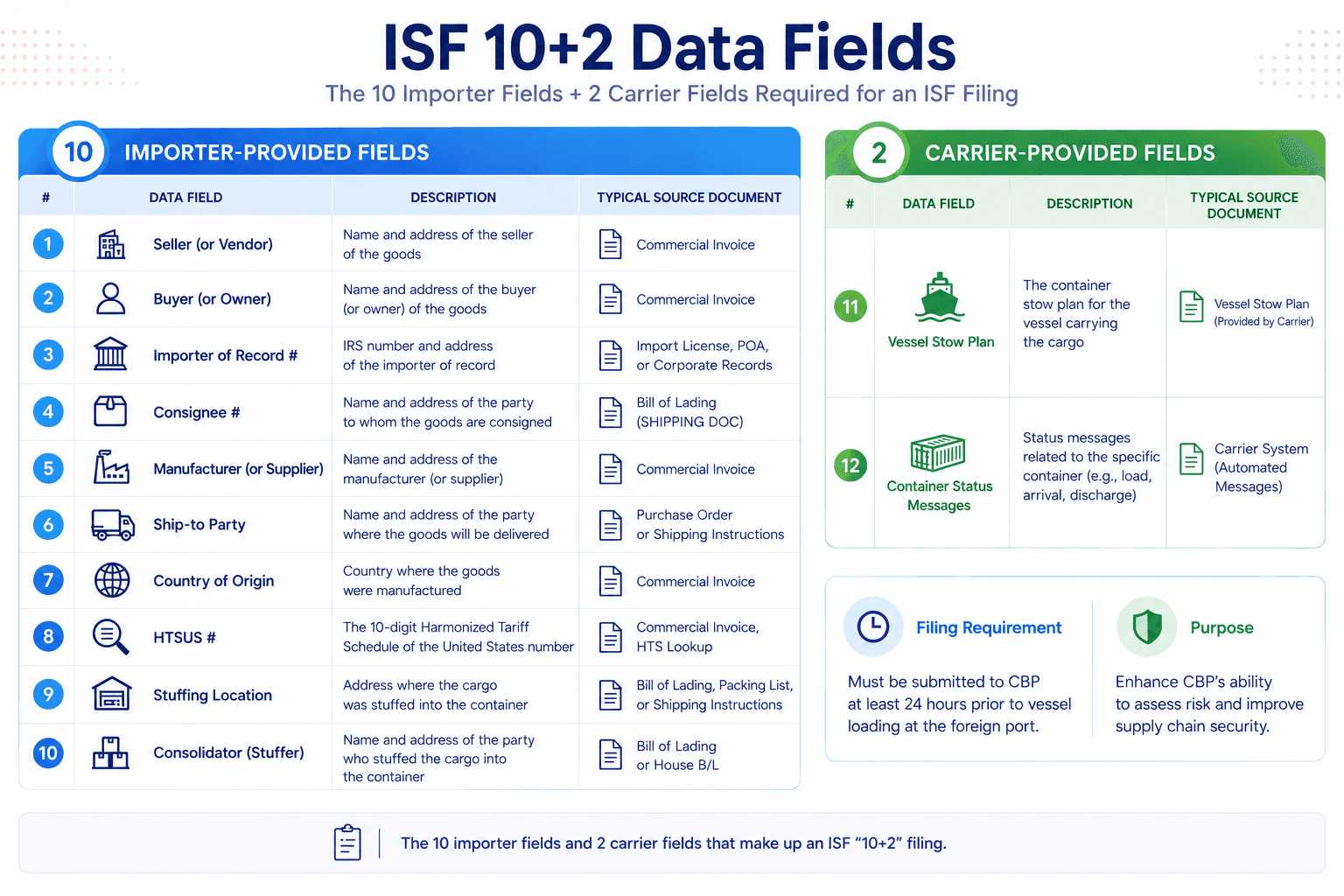
An ISF is a set of data fields, not a paper form you fill in. Ten of those fields come from the importer, and they cover who is behind the shipment and what is in the box. The last two come from the ocean carrier instead. Put together, all 12 tell CBP what is inside the container and who is responsible for it before the ship ever leaves.
The 10 Fields the Importer Provides
Seller – the company or person selling the goods.
Buyer – the company or person buying the goods.
Importer of record number – the ID (or foreign trade zone ID) of the party who is legally responsible for the shipment.
Consignee number – the ID of the US party the goods are being shipped to.
Manufacturer or supplier – who actually made the goods, or who supplied them.
Ship-to party – the place the goods go once they clear customs.
Country of origin – the country where the goods were made.
HTSUS tariff number – the code that classifies what the goods are, for customs purposes.
Container stuffing location – the place where the goods were packed into the container.
Consolidator – the party who packed the container or arranged for it to be packed.
The 2 Fields the Ocean Carrier Provides
Vessel stow plan – a map showing where every container sits on the ship.
Container status messages – electronic updates on the container's journey, like "entered the gate" or "loaded onto the ship."
Where It's Used
An ISF sits right at the start of a US ocean import, before the goods leave the foreign port. It shows up in any business that brings goods into the US by sea, so you see it most in retail, manufacturing, and any company importing raw materials or finished products.
The people who actually handle it are operations and logistics teams, along with the customs brokers and freight forwarders who file the paperwork. Finance and compliance staff get pulled in too, but usually only after a penalty or a held container lands on their desk. In a lot of mid-sized importers, one operations or finance lead quietly owns ISF accuracy on top of their regular job, since a single missed filing can turn into a bill fast.
How It's Used
The information an ISF needs is not sitting in one neat place. It is scattered across documents the importer already has, so the seller and buyer come off the purchase order, the manufacturer and country of origin come off the commercial invoice, and the container details come off the bill of lading or the booking. Someone has to gather all 10 fields, look up the right HTSUS code for the goods (at least the first 6 digits), and send it to CBP through the Automated Broker Interface at least 24 hours before the container is loaded. CBP then sends back an acceptance and a unique ISF number.
There is one trap that catches people. The bill of lading number on the ISF has to match the number on the carrier's manifest exactly, and if it does not, CBP treats the whole filing as if it was never sent. The numbers involved come from different documents, often in different formats and from different senders, so a single wrong digit is enough to trigger a rejection or a penalty. Most importers file two or three days before loading instead of waiting until the last hour, which leaves time to catch and fix a mistake before the deadline passes.
Example
A US furniture company buys a container of chairs from a factory in Vietnam. Before that container can be loaded at the port in Ho Chi Minh City, the company's customs broker files the ISF. The broker names the Vietnamese factory as the manufacturer, lists Vietnam as the country of origin, adds the HTSUS code for wooden seating, fills in the buyer and the seller, names the US warehouse as the ship-to party, and enters where the container was packed. To stay safe, the broker sends it 48 hours before loading, which leaves room to correct a typo.
CBP accepts it and returns an ISF number. The chairs load on schedule, with no hold and no fine.
Types and Variations
ISF-10
The ISF-10 is the standard, full-length filing, and it is the one most importers deal with. It is used when goods are actually being brought into the United States, including goods heading to a foreign trade zone. All 10 importer fields are required, which is why it is called the "10" in "10+2." If you are a company buying products from overseas to sell or use in the US, this is the version your broker files for you.
ISF-5
The ISF-5 is a shorter, 5-field version for cargo that is only passing through the US rather than entering it. It covers three situations: freight that stays on board the ship and never comes off (FROB), cargo that is unloaded and immediately shipped back out (immediate exportation, or IE), and cargo that moves across the US to leave from another point (transportation and exportation, or T&E). Because the goods are not really entering US commerce, CBP asks for far less information. Carriers and the companies that arrange these transit shipments are the ones who usually handle it.
Unified Filing
A unified filing is when the ISF and the customs entry are sent to CBP together in a single electronic transmission. Some fields, like the importer number and the HTSUS code, are needed on both, so filing them as one saves entering the same data twice. It is mostly a convenience for brokers and importers who want fewer separate steps and less chance of the two filings disagreeing with each other.
Single Bond vs. Continuous Bond
Every ISF has to be backed by a customs bond, which is basically a financial guarantee that CBP will get paid if something goes wrong. A single transaction bond covers just one shipment, while a continuous bond covers a full year of activity, including entries and ISFs. Anyone who imports more than a handful of times a year usually goes with the continuous bond because it works out cheaper per shipment and there is nothing to arrange each time.
Self-Filed vs. Broker-Filed
An importer is allowed to file its own ISF using approved customs software, but most choose not to. The rules are detailed, the deadline is tight, and the penalties for getting it wrong are real, so the large majority hand the job to a licensed customs broker or a freight forwarder who files on their behalf. Self-filing tends to make sense only for bigger importers with their own in-house customs team.
FAQs
Is ISF filing the same as a customs entry?
No. An ISF is an advance security filing sent before the cargo is loaded overseas, so CBP can screen the container before it sails. The customs entry (CBP Forms 3461 and 7501) is filed around arrival to release the goods and pay the duty owed. They are two separate filings with different deadlines, though some of the same data can be reused if they are sent together as one transmission.
Who is responsible if the broker files the ISF wrong?
The importer of record is. Even when a customs broker or freight forwarder actually sends the ISF, the legal responsibility for getting the data accurate, complete, and on time stays with the importer. That is why importers who take compliance seriously keep a close eye on the source documents the filing is built from, instead of assuming the broker will catch every error for them.
What happens if you file late or not at all?
CBP can charge liquidated damages of $5,000 for each violation, up to a cap of $10,000 per ISF, for filings that are late, wrong, incomplete, or missing. The money is not the only problem. The cargo can be held, flagged for inspection, or hit with a "do not load" order at the origin port, and any of those will delay the shipment and pile up storage and container fees while it waits.
Does ISF filing apply to air freight?
No. An ISF only applies to cargo arriving by ocean ship. Goods coming in by air, truck, or rail are not covered by the 10+2 rule. Air cargo has its own separate advance-screening program called ACAS (Air Cargo Advance Screening). So if your goods are flying into the US rather than sailing, you do not file an ISF for them.
What documents do you need to complete an ISF?
You build an ISF from documents you already have. The purchase order gives you the buyer and seller, the commercial invoice gives you the manufacturer, country of origin, and a description of the goods, and the bill of lading or booking gives you the bill number and the container details. You also need the HTSUS classification for the goods. The hard part is rarely finding the documents. It is making sure every field agrees across all of them before the 24-hour deadline.
Related Blogs



Turn documents into decisions.
See how Docxster gets you from inbox to insight in minutes, not days. Bring your toughest workflow — we'll show you what it looks like solved.


