-
PGA & FDA Holds: How Brokers Catch Them Before the Entry Files
Stuck with a PGA hold? Learn why they happen, what they cost, and how to catch the requirement at intake instead of at the port.
Last updated:


A PGA hold looks like something that happens at the port. It is usually decided much earlier, the moment a product is classified and its entry is keyed.
The requirement that holds the shipment is tied to the HTS code and sits in the documents you already have. The problem is that most brokers see it too late to act on it without delay.
In this guide, we walk through what a PGA hold is, why it happens, how the HTS code carries the requirement, and how to catch it at intake before it turns into a hold.
What is a partner government agency (PGA)
A Partner Government Agency (PGA) is a U.S. federal agency that works with U.S. Customs and Border Protection (CBP) to regulate specific categories of imported goods. These agencies are what stands between your shipment and PGA release in customs.
CBP manages the entry of merchandise into the United States, while PGAs apply the product-specific rules related to areas such as food safety, agriculture, environmental protection, consumer safety, wildlife conservation, and vehicle standards.
Depending on the product, an importer may need to provide additional data, permits, certifications, or other documentation before the shipment can be released.
The agencies brokers deal with most
The PGAs most commonly involved in imports include:
FDA: Regulates foods, drugs, medical devices, cosmetics, and other related products. For FDA customs clearance, importers often need to consult specialists who understand the agency’s specific filing requirements.
USDA and APHIS: Oversee agricultural goods, plants, animals, and animal products.
EPA: Regulates chemicals, pesticides, vehicles, and engines.
FWS: Oversees wildlife and wildlife products.
CPSC: Regulates certain consumer products.
NHTSA: Sets safety requirements for imported vehicles and related equipment.
What is a PGA hold and what it costs
A PGA hold is a shipment delay caused by a Partner Government Agency (PGA) reviewing imported goods for compliance with its specific regulations. The hold may involve a request for additional information, a missing permit, an inspection, laboratory testing, or a decision about whether the goods can enter the United States.
The agency involved depends on the product. For example, the FDA may review food or medical devices, while the USDA and APHIS may examine agricultural products, plants, or animal goods.
A PGA hold is different from a customs hold initiated by CBP. A CBP customs hold may stop a shipment for customs, security, valuation, classification, or admissibility reasons. A PGA hold relates to the requirements of another federal agency, although CBP coordinates the import process and cannot release the goods until the agency’s requirements are satisfied.
The cost of a PGA hold
The cost depends on how long the shipment remains on hold and what action is needed to resolve it.
Cost area | How the cost arises |
|---|---|
Storage | The container or cargo remains at the terminal while the agency review is pending. |
Demurrage | The terminal may charge fees when the container stays beyond the permitted free time. |
Detention | The carrier may charge fees when equipment is not returned within the allowed period. |
Manual processing | Brokers and import teams spend additional time entering product-level PGA data, checking requirements, and responding to agency queries. |
Correction and delays | A missed or incorrectly disclaimed PGA requirement can send the entry back for correction, creating another round of work and delaying PGA release for customs. |
Carriers or marine terminal operators generally bill demurrage and detention. The Federal Maritime Commission’s final rule on detention and demurrage billing practices took effect on May 28, 2024, and sets requirements for who may be billed, what invoices must contain, and how billing disputes and requests for fee mitigation are handled.
The internal cost of a customs hold can also be substantial. As one customs brokerage professional put it, “if we are manually doing all of the PGA information it takes a toll on our team and our productivity.”
A PGA hold does not have one fixed price. The final cost depends on the carrier and terminal’s charges, the length of the delay, the type of cargo, and how much manual work is required to correct or complete the entry and secure customs PGA release.
Also Read: 5 Signs You’re Scaling Customs with Headcount, Not Process
Why PGA holds happen
Here are the main reasons PGA holds happen for customs brokerage professionals and delay pga release customs:
1. Missing or incomplete PGA data
A PGA message set may require product codes, manufacturer details, facility registrations, country information, quantities, intended-use codes, permits, or affirmations of compliance. If a mandatory field is missing or submitted in the wrong format, the agency may reject the data or place the entry into additional review.
The FDA’s official error guidance includes examples such as missing product codes, incomplete entity addresses, missing food facility registrations, invalid quantities, and missing container numbers. The FDA also states that these errors can delay the initial screening and review of an entry.
2. Data mismatches across documents
A hold can also occur when the information in the PGA filing does not match the commercial invoice, packing list, bill of lading, or any related documentation.
Common examples include:
The manufacturer in the PGA data does not match the manufacturer shown on the invoice.
The FDA product code does not match the product description.
The quantity or unit of measure differs between the entry and the shipping documents.
The facility registration does not match the manufacturer name and address.
The country of production, source, or growth is reported incorrectly.
The FDA specifically warns that an incorrect manufacturer, product code, quantity, shipper, consignee, or product description may lead to unnecessary holds or additional review. It also identifies mismatches between a food facility registration and the reported manufacturer as a specific error that blocks PGA release for customs.
3. Late detection of PGA requirements in the filing system
The HTS code can indicate that a PGA requirement applies, but many brokers discover the requirement only after the entry has been keyed into their filing system. If the broker is working from incomplete documents or must enter PGA data manually, the issue may not become visible until the filing is transmitted, at which point customs PGA release is already at risk.
That creates a preventable delay. The broker may then need to contact the importer or supplier, obtain missing product details, correct the entry, and wait for the agency to review the revised information.
The official error data shows why late detection is operationally important. FDA’s list of common errors includes incorrect product codes, manufacturer information, quantities, descriptions, intended-use codes, and line-item grouping.
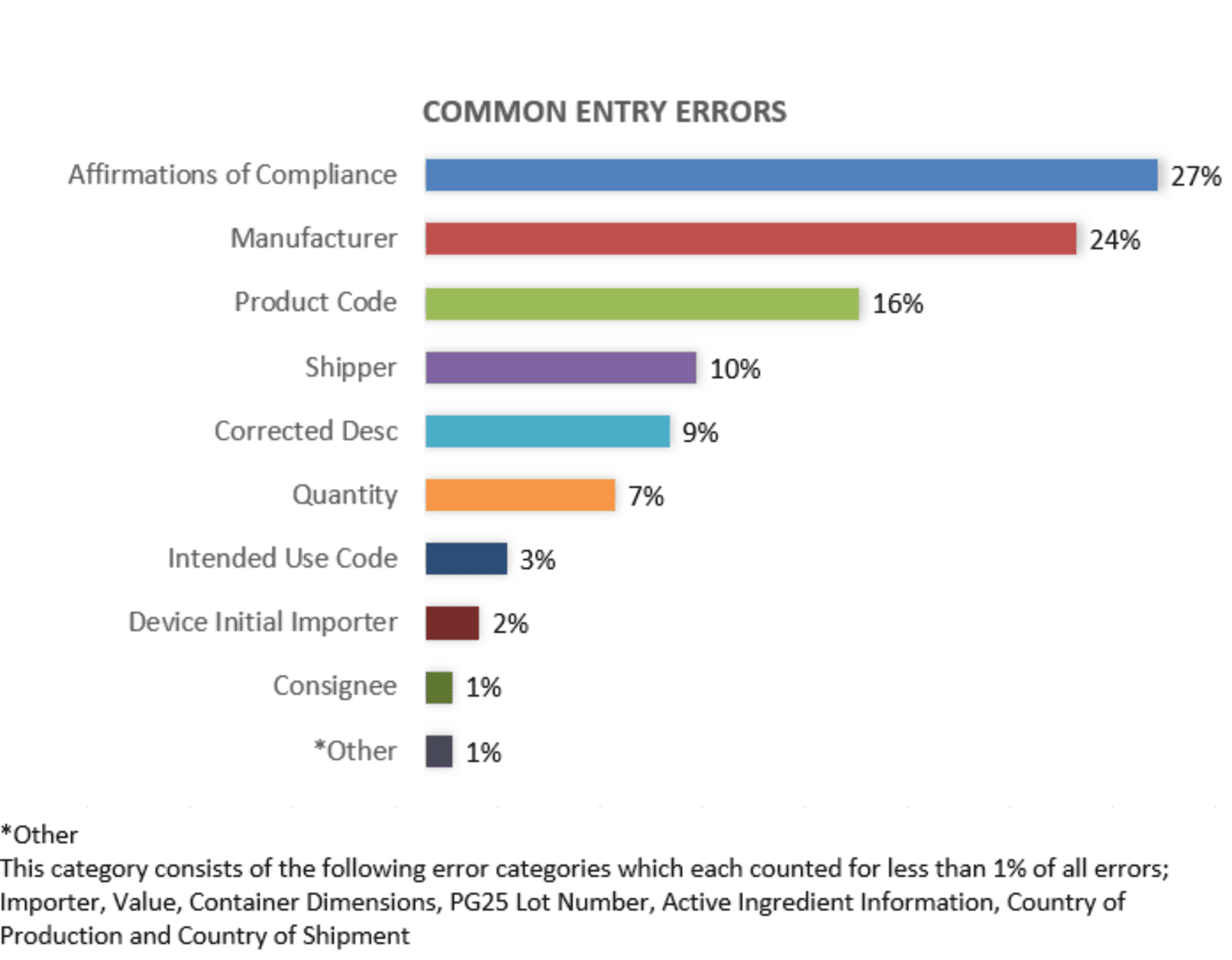
An image showing common entry errors by percentage
Source
The role of the HTS code in a PGA hold
In the Automated Commercial Environment (ACE), PGA requirements are linked to the Harmonized Tariff Schedule (HTS) code. Each HTS code indicates whether a product may fall under the jurisdiction of an agency such as the FDA or USDA. The PGA flag is therefore triggered when the product is classified under the relevant HTS code.
The flag itself is not hidden. It is attached to the HTS code and can be identified as soon as the product is correctly classified. The practical problem is that many brokers see the requirement only after the entry has been entered into and processed by their brokerage software. By then, every line may already have been keyed in manually.
As one broker explained, “each classification number has PGAs associated with it,” but “I have to wait until I upload it into my brokerage system.”
This creates a timing problem:
The HTS classification determines whether a PGA requirement may apply.
The brokerage system surfaces the requirement after the entry data is uploaded.
If the requirement is discovered late, the broker may need to collect missing information, revise the entry, or respond to a hold before the goods can be released.
Screening HTS codes for PGA requirements before filing allows brokers to identify issues early and minimize rework.
How to reduce future PGA holds
The requirement that holds a shipment is already in the documents when they land on your desk. Catching it there, before anyone keys the entry, is the whole difference between a flag you can handle and a hold you cannot.
That means running the PGA check at intake, and it breaks into four steps that each move a decision earlier than the filing screen would:
1. Screening PGA requirements at intake
Right now the requirement tends to surface once the entry is already in the filing system, because that is the first point the software reads the classification back to you.
Your team works out which agency applies from the product and past entries, keys the lines, and only then sees the flag, with the cargo already close to port and little time left to gather what the agency wants.
Docxster suggests the HTSUS code for every line straight from the invoice description and holds it for your reviewer to confirm, so the classification is done while the shipment is still a stack of documents.
Since the code is what decides whether FDA, USDA, or another agency has a say in the line, classifying at intake tells you which entries carry a PGA requirement before you have built a single one, which is the point where you still have room to act on it.
Watch our YouTube video on how you can automate customs entries: ISF, 7501, 7512 & HTS.
2. Confirming the PGA data set is complete
A PGA hold rarely comes from a document that is missing altogether. It comes from a field left blank inside one that is present. An FDA line needs a product code, an end-use code, the affirmations of compliance, and the units in the format the agency expects, and any one of those can be empty on an entry where every certificate is attached and nothing looks wrong to the eye.
Docxster runs this as its PGA document validation, reading the entry against the required elements for the agency in question and surfacing the fields that are missing or wrongly formatted before anything is filed.
What comes back is not a pass or fail but the specific list of what a reviewer still has to complete, and it comes back while the shipper is reachable and the cargo has not sailed, which is the only window where fixing it is cheap.
3. Reconciling the certificate against the goods
A certificate can be present and still not cover what is actually on the entry, because the product named on the certificate and the product on the invoice have to be the same product, and under deadline that comparison is the first thing to get skipped.
Docxster reads each certificate alongside the invoice, packing list, and BOL and surfaces the ones that do not line up with the goods on the entry, so a mismatch between the certificate and the shipment is caught at your desk rather than at the border.
4. Filing checked data and keeping the record
Even when the PGA data is complete, a hold still lands when the numbers disagree across the paperwork, so the last step is making sure the entry that goes in matches every document behind it. By hand this is an entry writer reading three or four documents side by side and comparing them line by line, which is where two to four hours of a broker’s day goes and where a mismatch slips through anyway.
Docxster pulls the line data once, compares consignee, weight, pieces, value, and origin across the documents, and surfaces only the fields that disagree, then carries the same HS code through and sends the checked data to your entry platform.
It keeps a record of every document it read, what matched, and who approved it, tied to the entry, so if CBP comes back with a CF-28 later you are not reconstructing the decision from scattered email.
Catching a PGA hold before it happens
A PGA hold is set in motion the moment the product is classified. The agency’s requirement is fixed, and once the container is at the port, the review runs on the agency’s timeline, not yours. The only thing in your control is how early you identify the requirement and how cleanly the data is ready before you file.
Most of what you need is already in the documents on your desk. The HTS code tells you an agency is involved, and the PGA data sits in the invoice, the certificates, and the registrations you already hold. Holds happen for two reasons: the fields you have to chase from the shipper, and the values that get mis-keyed on the way into the entry. Fix how the data is collected and checked, and the requirement surfaces while there is still time to handle it.
That is the part Docxster handles. It reads the documents, classifies the lines, checks the fields that have to agree, and gives you a complete entry to approve before it files, without changing the software you file through. Book a demo to see it run on your own documents.
FAQ
What triggers a PGA hold?
A PGA hold is triggered when an agency's requirement on the entry is missing, incomplete, or does not match the shipping documents. The requirement itself is tied to the HTS code, so it applies the moment the product is classified.
What is the difference between a CBP hold and a PGA hold?
A CBP hold stops a shipment for customs reasons such as valuation, classification, or security. A PGA hold relates to another federal agency's rules, and CBP cannot release the goods until that agency's requirements are met.
Does the HTS code determine PGA requirements?
Yes. In ACE, PGA requirements are linked to the HTS code, so each code indicates whether an agency like FDA or USDA has a say in the line. The flag exists as soon as the product is correctly classified.
Can a PGA hold be prevented before filing?
Yes. Because the requirement is knowable at classification, screening the HTS code and checking the PGA data at intake lets you catch it while the shipper is reachable, rather than after the entry is transmitted.
How much does a PGA hold cost?
There is no fixed figure. The cost depends on the carrier and terminal charges for storage, demurrage, and detention, the length of the delay, and the manual work needed to correct or complete the entry.
Turn documents into decisions.
See how Docxster gets you from inbox to insight in minutes, not days. Bring your toughest workflow — we'll show you what it looks like solved.


