-
10 No-Code Automation Statistics: What Adoption Actually Looks Like in 2026
How automated are teams in 2026 and what do no-code adopters do differently? Here’s a breakdown of the no-code automation market—with tips on how to do better.
Last updated:

TL;DR
No-code automation is growing quickly across enterprise software, but document-specific adoption is still low among finance, operations, and IT teams.
Only 13.2% of surveyed teams use no-code workflow tools for document work, while most still rely on spreadsheets, email, and ERP-native workflows.
Operations teams are the slowest adopters, with only 9.7% using no-code workflow tools despite dealing with highly variable document processes.
Teams that adopt no-code are more automated: 53.7% describe their work as mostly or largely automated, compared with 41.6% of non-adopters.
The next phase of no-code automation will likely depend on AI-enabled tools that can read unfamiliar document formats and adapt without constant rule rebuilding.
No-code automation has been one of enterprise software's favorite promises for half a decade now, and the pitch for it is just about everywhere. What is harder to find is a clear read on how many teams actually use it, and whether the ones that do are any better off for having made the switch.
So we measured it. At Docxster, we surveyed 310 finance, operations, and IT leaders in early 2026—and set the findings against recent figures from Gartner, Forrester, and independent research.
The 10 statistics that follow answer both of those questions and shed light on where the category looks to be heading next.
How widespread is no-code automation adoption in 2026?
The no-code headlines and the no-code reality point in opposite directions. The broader market is racing toward mainstream-default status, while document-specific adoption inside finance and operations teams is still early. These four statistics show both pictures:
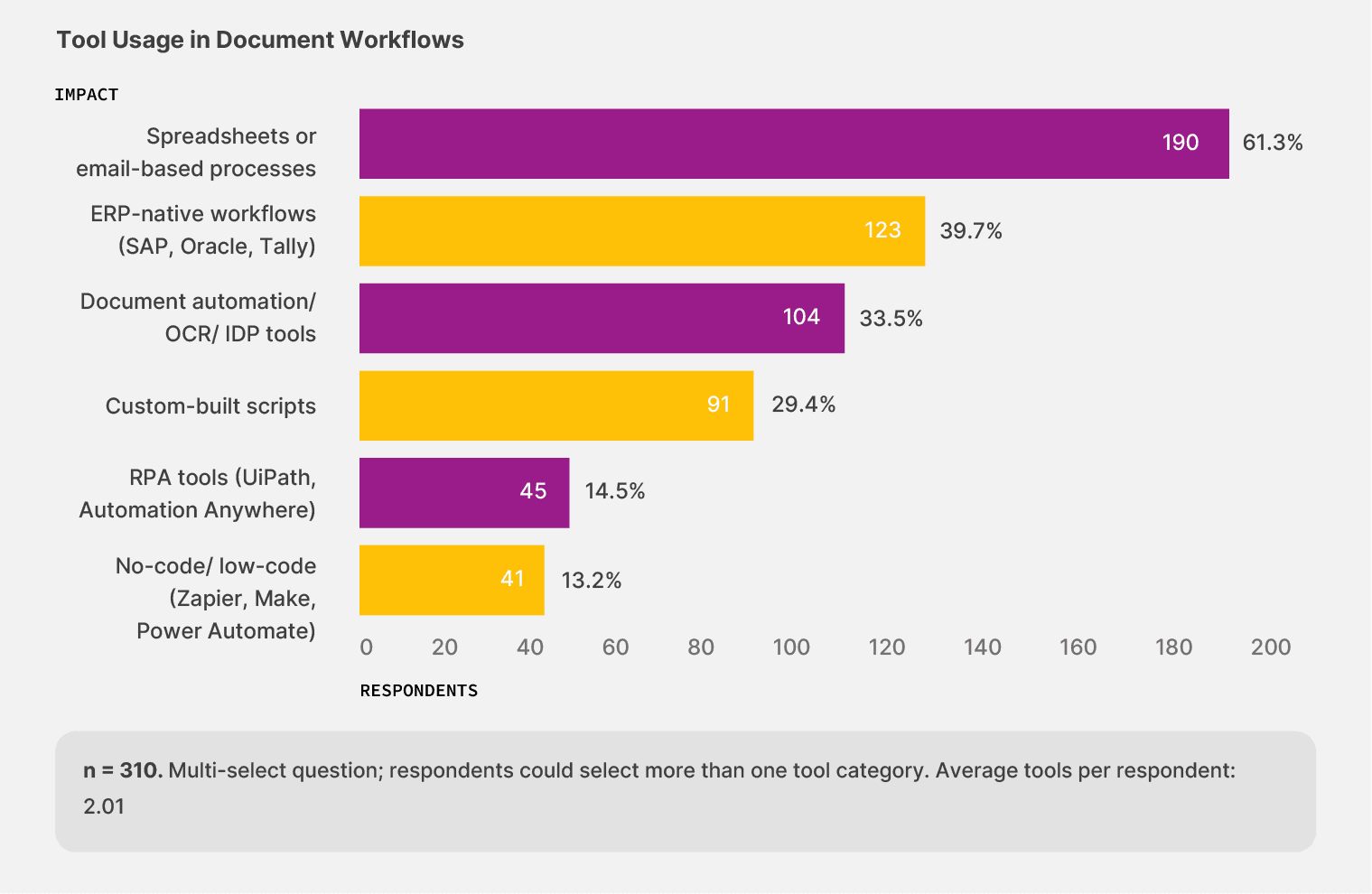
#1: Only 13.2% of teams use no-code workflow tools for document work
According to Docxster's 2026 State of No-Code Document Automation survey of 310 finance, operations, and IT leaders, only 13.2% use no-code workflow tools to handle document work, the lowest adoption rate of any tool category in the study. The old guard still dominates: spreadsheets and email-based processes handle document work for 61.3% of teams, and enterprise resource planning (ERP)-native flows work for the other 39.7%.
No-code tools are built for exactly the kind of documents these teams deal with every day. Picture an invoice or a delivery note that arrives in a slightly different layout each time—sometimes as a clean PDF and sometimes as a photo someone snapped on their phone.
That’s the hardest paperwork to automate and get through by hand, and it’s precisely the work no-code tools are meant to take off people's plates. So it’s striking that this is the tool the fewest teams have actually adopted.
#2: 60% of dev organizations will run on enterprise low-code by 2028
According to Gartner's 2025 Magic Quadrant for Enterprise Low-Code Application Platforms, 60% of software development organizations will use enterprise low-code application platforms as their main internal developer platform by 2028, up from just 10% in 2024.
That’s a sixfold jump in four years. Low-code is on track to become the default way enterprises build software, rather than a side tool. What is in question is how little of that momentum has reached document-specific work, where adoption sits at 13.2%.
#3: The low-code market could grow from $13.2B to nearly $50B by 2028
Forrester estimates the combined low-code and digital process automation market reached $13.2 billion at the end of 2023, growing roughly 21% a year. It projects the market to reach about $30 billion by 2028, with an AI-fueled upside scenario that could push it toward $50 billion. Forrester also found 87% of enterprise developers already use low-code for at least some of their work.
It goes to show how the category has evolved from basic automation to low-code automation. But in 2026, low-code isn’t the goal anymore. When we set it against the fact that only 13.2% of teams have adopted no-code tools, the document automation gap becomes impossible to miss.
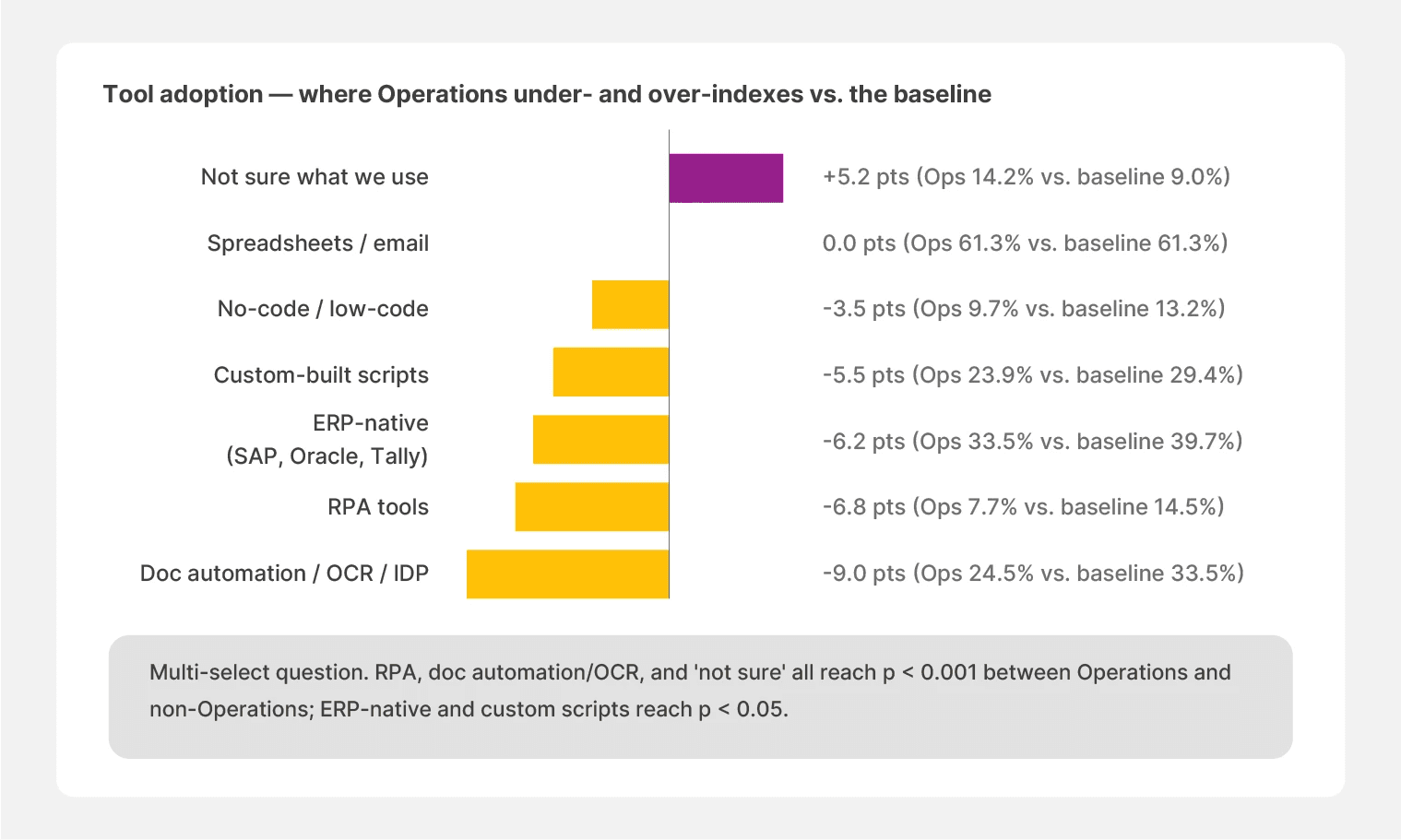
#4: Among Operations teams, only 9.7% use no-code workflow tools
According to Docxster’s survey, among operations teams—the segment with the fewest dedicated IT employees and the most document variability—only 9.7% use no-code workflow tools. That puts it about a quarter below the survey average of 13.2%, and it’s the lowest adoption of any segment in Docxster's survey. The teams the category fits best have adopted it the slowest.
What no-code adopters do differently
The teams that have adopted no-code tools are measurably ahead of the ones that haven't. Below are the three differences that came through most clearly:
#5: No-code adopters tend to be “more automated” than everyone else
According to Docxster's findings, 53.7% of no-code adopters describe their automation as "mostly or largely automated," compared with 41.6% across the rest of the sample. That’s a 12-point maturity gap between the teams that have adopted no-code workflow tools and those that have not.
The category sitting at the bottom of the adoption curve is the one producing the most automated teams. Early movers are not waiting for the rest of the field to catch up. They’re compounding the lead one workflow at a time, and the distance grows every quarter while the rest of the field stays on the old stack.
#6: Adopters report development up to 60% faster
The speed advantage shows up outside Docxster's data, too. A 2025 Forrester Total Economic Impact study found that organizations reported 60% faster application development compared with traditional high-code environments, with new developers becoming productive 80% faster. The composite organization in the study reached a three-year return on investment (ROI) of 363% and paid back its investment in under six months.
The is consistent with Docxster’s findings. Teams that adopt low-code and no-code tools move faster, ship more, and ramp people up sooner.
#7: Adopters of automation tend to have more trust-related concerns
According to Docxster's survey, no-code adopters have an average of 2.51 trust concerns about document automation, compared with 2.08 for non-adopters. The teams using the tools the most are also the teams raising the most flags.
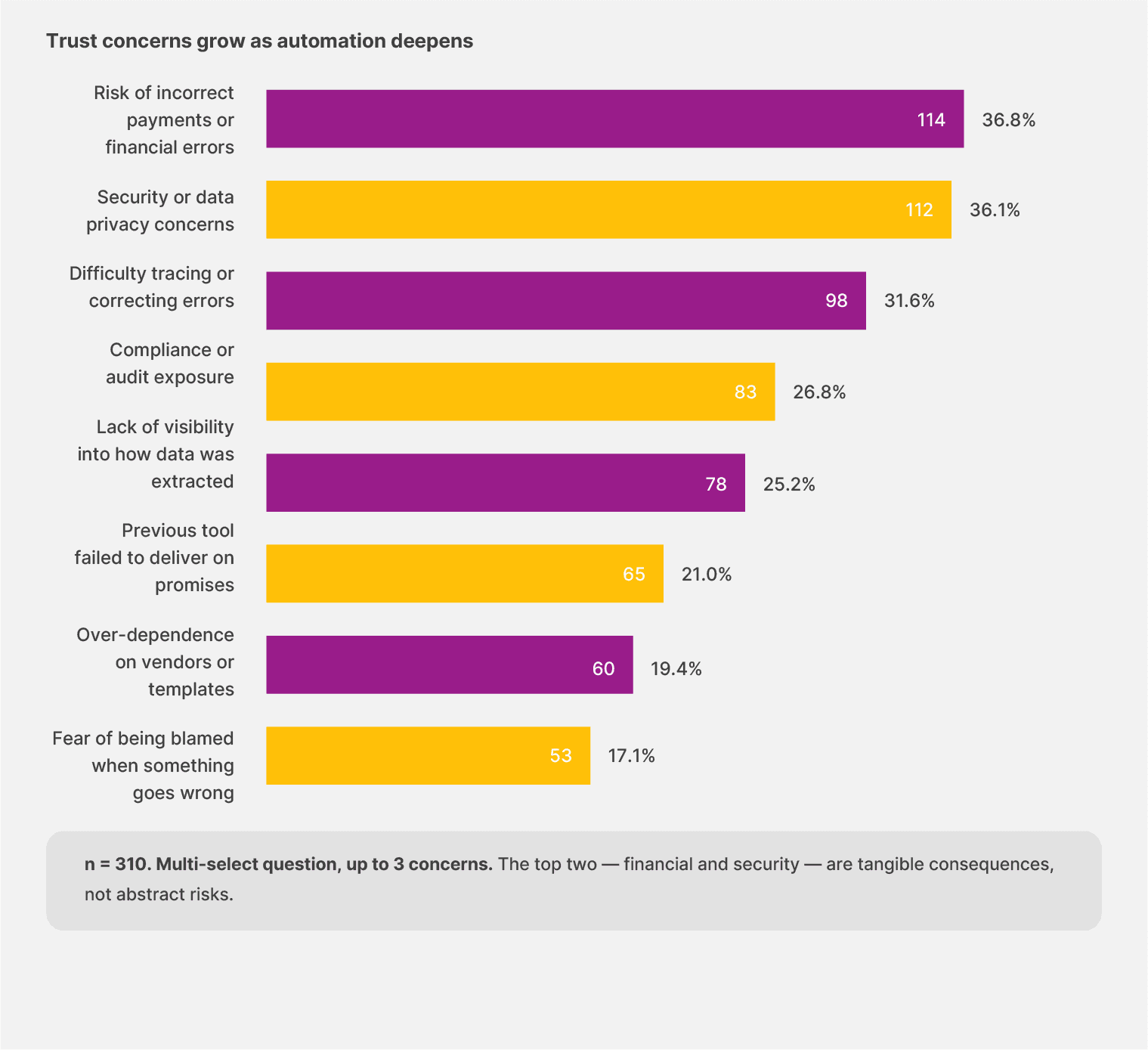
The higher number doesn’t mean no-code is letting these teams down. It means they understand the work better than the teams that haven’t tried it. The people using these tools every day have seen where automation gets things wrong, so they know what to look out for. Teams that have not adopted no-code raise fewer concerns mainly because they have less hands-on experience, not because their current setup is any safer.
For a buyer, the point is simple. The teams further ahead than you are both more automated and more aware of what can go wrong. Their concerns are a useful list of things to check before you commit, not a reason to hold off.
Where the no-code automation market is headed
So far, we’ve discussed where document automation stands today. But an even more useful question is where will it go next? The data points in a clear direction. Here’s what we found:
#8: 38.7% of non-adopters of automation are open to changing tools within a year
According to Docxster's 2026 survey, 38.7% of teams that haven’t yet adopted no-code workflow tools say they’re open to changing their tools in the next 12 months. With 269 of 310 respondents still outside the adopter base, that’s a large pool actively willing to move.
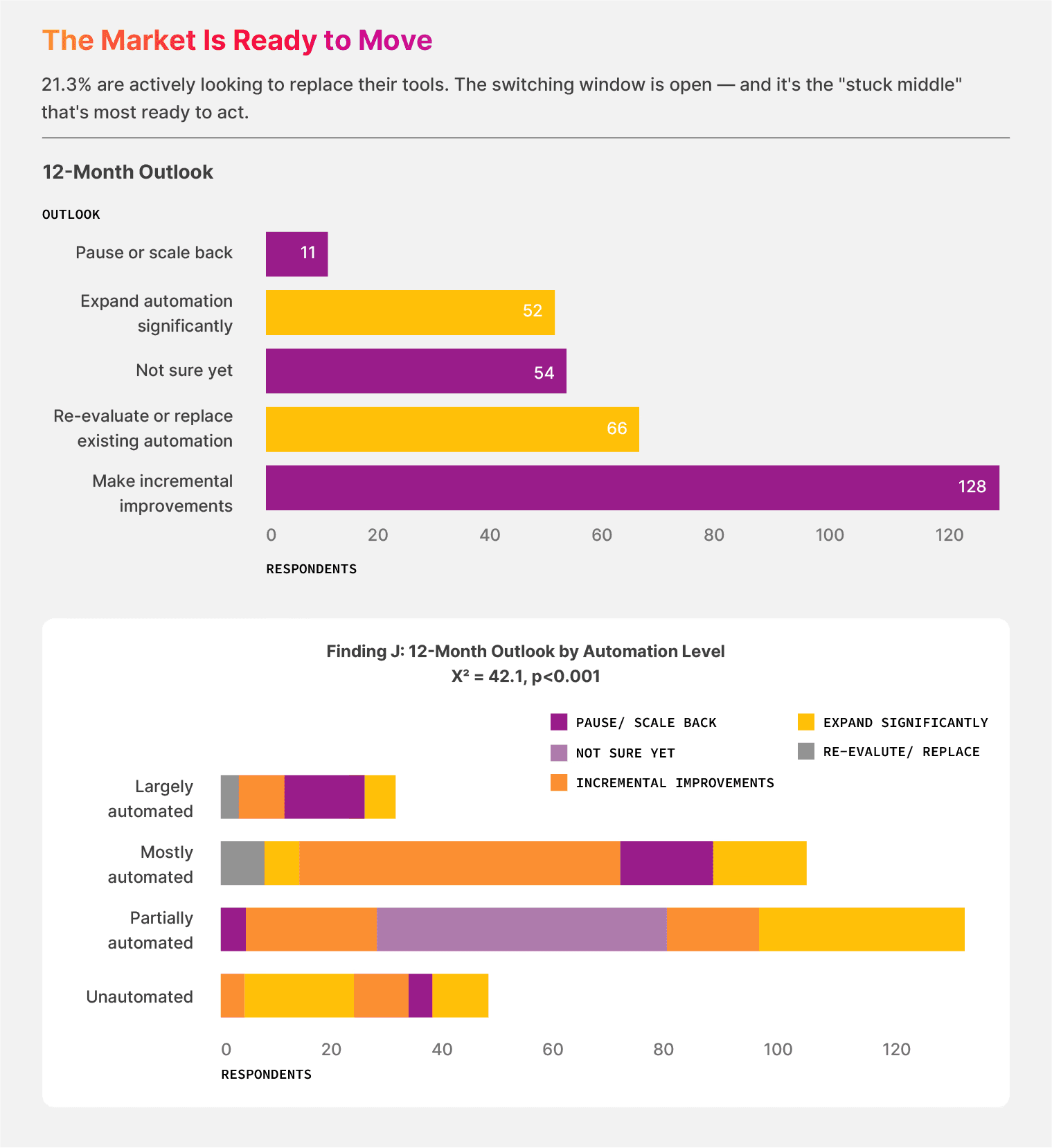
The teams most ready to switch are the ones stuck in the middle of the maturity curve. They have lived with their current setup long enough to know its ceiling, and they’re now looking for what comes next. That means the market is far from settled, and a good share of these teams could switch tools within the next year.
#9: Agentic AI will be in a third of enterprise software by 2028
What comes next is AI-augmented. According to Gartner, 33% of enterprise software applications will include agentic AI by 2028, up from less than 1% in 2024. Agentic AI refers to software that can interpret a goal, make a plan, and take multi-step action with little human input, turning a static workflow into one that adapts to a document it has never seen.
For document work, this is the part that matters to you. A no-code tool that only follows fixed rules still breaks the moment an invoice shows up in a layout it has not seen before. What you actually need is no-code that can read an unfamiliar document and pull the right details from it, without you or your team rebuilding the rules every time a supplier changes its format.
That, more than the no-code label itself, is what you should be shopping for.
#10: A quarter of business staff outside IT now build technology
The structural shift underneath all of this is who does the building. According to Gartner's 2025 CIO and Technology Executive Survey, an average of 26% of business and corporate staff outside of IT are now dedicated to building, implementing, or managing technology. The work is moving to the people closest to it.
That is the engine behind no-code adoption. When the person who reads the document can also change the workflow, the IT-only model stops being the default. The market is heading toward tools built for that reality.
No-code automation is the least adopted but most effective
If your team spends real time on documents, the pattern in these numbers is worth acting on. The teams that have moved to no-code are already automating more of that work than everyone else, and their lead grows every quarter while the rest of the market waits.
And the tools keep improving, so the teams already using no-code are getting further ahead, not staying put. The longer you wait to start, the more you may have to make up later.
You don’t have to take our word for it. The full report behind these 10 stats, including the dataset and methodology, is on Docxster's research page. You can find it here:
The State of No-Code Document Automation in 2026
FAQs: No-code Automation Statistics
What is no-code automation?
No-code automation lets business teams build and manage workflows without writing traditional code. For finance and operations teams, that often means automating repetitive document tasks like extracting data from invoices, delivery notes, forms, or PDFs.
How common is no-code automation adoption in 2026?
The article shows that adoption is still uneven. While low-code and no-code platforms are gaining momentum across enterprise software, only 13.2% of surveyed teams currently use no-code workflow tools for document work.
Why is no-code adoption still low for document work?
Many teams still rely on familiar tools like spreadsheets, email, and ERP-native workflows. Document automation is also difficult because invoices, forms, and delivery notes often arrive in inconsistent formats, which makes teams cautious about switching tools.
Which teams are slowest to adopt no-code automation?
Operations teams appear to be the slowest adopters in the article. Only 9.7% of operations teams surveyed use no-code workflow tools, even though they often deal with high document variability and fewer dedicated IT resources.
Do no-code adopters actually automate more work?
Yes. According to the article, 53.7% of no-code adopters describe their automation as mostly or largely automated, compared with 41.6% of teams that have not adopted no-code tools.
What are the main benefits of no-code automation?
The biggest benefits are faster workflow creation, less dependence on IT, and more flexibility for teams closest to the work. External market coverage also points to low-code and no-code as tools that help organizations accelerate application and workflow development.
What risks should teams consider before adopting no-code automation?
Teams should pay close attention to trust, governance, security, and accuracy. The article notes that adopters actually report more trust-related concerns than non-adopters, which suggests experienced users are more aware of where automation can fail.
How will AI change no-code automation?
AI is likely to make no-code tools more adaptive. Instead of relying only on fixed rules, AI-enabled workflows may be able to understand unfamiliar document layouts and extract the right information with less manual setup.
What should finance and operations teams look for in a no-code automation tool?
They should look for tools that can handle messy, variable documents—not just clean, standardized files. The article argues that buyers should prioritize automation that can read unfamiliar documents and adapt when suppliers or formats change.
Is no-code automation worth adopting now?
For teams spending significant time on document-heavy work, the article’s argument is yes. Adoption is still early, but teams already using no-code tools appear to be more automated and better positioned as the category improves.
Turn documents into decisions.
See how Docxster gets you from inbox to insight in minutes, not days. Bring your toughest workflow — we'll show you what it looks like solved.


