-
How to Measure Document Automation Maturity: The DAMI Framework
Score your document automation maturity across 6 dimensions with DAMI—built from Docxster's 2026 survey of 310 finance, operations, and IT leaders.
Last updated:


TL;DR
DAMI is a five-level framework for measuring document automation maturity based on how work actually moves through people, systems, and exceptions.
The five maturity levels are Manual, Partial, Mostly automated, Largely automated, and Fully automated.
The framework scores maturity across six dimensions: automation level, ownership structure, intake variability, human review design, trust concerns, and 12-month outlook.
Most teams are not fully automated; the largest share, 41.9%, sits at Level 2: Partially automated.
Level 2 is often the most expensive place to stay because teams have invested in automation but still spend significant time cleaning up exceptions.
Level 3 teams have meaningful automation in place, but review remains the bottleneck because humans still validate most documents.
Level 4 teams rely more on spot-checking and confidence-based review, but edge cases and trust concerns become more important.
Level 5 is still rare and shifts the challenge from extraction to governance, audit trails, access controls, and compliance.
DAMI can help teams benchmark their current state, evaluate vendors, and set realistic maturity goals for the next 12 months.
You’ve invested in tools, built workflows, and automated what you can. But when someone asks how mature your document automation actually is, the answer usually comes back as a feeling—not a number you’d put in front of a CFO.
That’s because the frameworks designed to answer that question weren’t built for document work. Analyst maturity models from Gartner or Forrester are paywalled, generic, or scoped to broader RPA. They measure tool adoption, not how your workflows behave when volumes spike, or a vendor changes their invoice format mid-quarter.
The Document Automation Maturity Index (DAMI) closes that gap. Built from Docxster’s 2026 survey of 310 finance, operations, and IT leaders across the US, UK, and Canada, DAMI scores maturity across six operational dimensions—not tool categories. What follows is the full framework and instructions for using it.
The 5 levels of document automation maturity
Most maturity models work like a credit score with no explanation behind the number. You get a tier, but you don’t know which behaviors put you there or what to change. DAMI works differently. It classifies your team based on how work actually moves through people, systems, and exception handling—scored across six dimensions:
Automation level—how much of the document flow runs without manual intervention
Ownership structure—whether IT, the business, or some unclear middle ground controls the workflow
Intake variability—how predictable your inbound documents are
Human review design—what humans do after the system runs
Trust concerns—what your team worries about when automation handles the work
12-month outlook—whether you’re expanding, replacing, or holding steady
The table below gives you the full picture at a glance. Each level is anchored by the percentage of the 310-respondent sample that falls within it.
Level 1: Manual | Level 2: Partial | Level 3: Mostly automated | Level 4: Largely automated | Level 5: Fully automated | |
|---|---|---|---|---|---|
% of sample | 14.8% | 41.9% | 33.5% | 9.7% | <1% (estimated) |
Typical tools | Spreadsheets, email, paper | ERP + spreadsheets, basic OCR, custom scripts | OCR/IDP + manual review queues, AP workflow tools | Integrated extraction-to-system pipelines, custom RPA | AI-augmented no-code platforms with exception-only review |
Human review | Everything is manual—review is the work | Heavy correction load; humans fix most extracted data | Regular review of most documents; spot checks not yet trusted | Spot checks on a sample; system handles 90%+ end-to-end | Exception-only; system processes 99%+ autonomously |
Key pain | No automation infrastructure; team time consumed by data entry | Intake variability breaks workflows; senior staff handle cleanup | Review bottleneck—humans validate every document, even when extractions are correct | Edge cases and vendor format changes; trust concerns increase with experience | Scaling governance; keeping audit trails clean at volume |
What good looks like | Pilot one high-volume document type through extraction | Move to templateless extraction with confidence-flagged review | Shift to sampling-based review with confidence routing | AI that adapts to new formats without retraining; business-led workflow changes | Governance and audit automation as the differentiator |
Now let’s walk through each level in detail:
Level 1: Manual (14.8% of teams)
Your team processes documents by hand—retyping data from PDFs into spreadsheets, forwarding invoices via email, and reconciling carrier bills against contracts one line at a time.
The cost is straightforward: your most experienced people spend their mornings on work that requires their availability, not their judgment. Think of it like running a warehouse where the logistics manager also drives the forklift. The expertise is there, but it’s pointed at the wrong job.
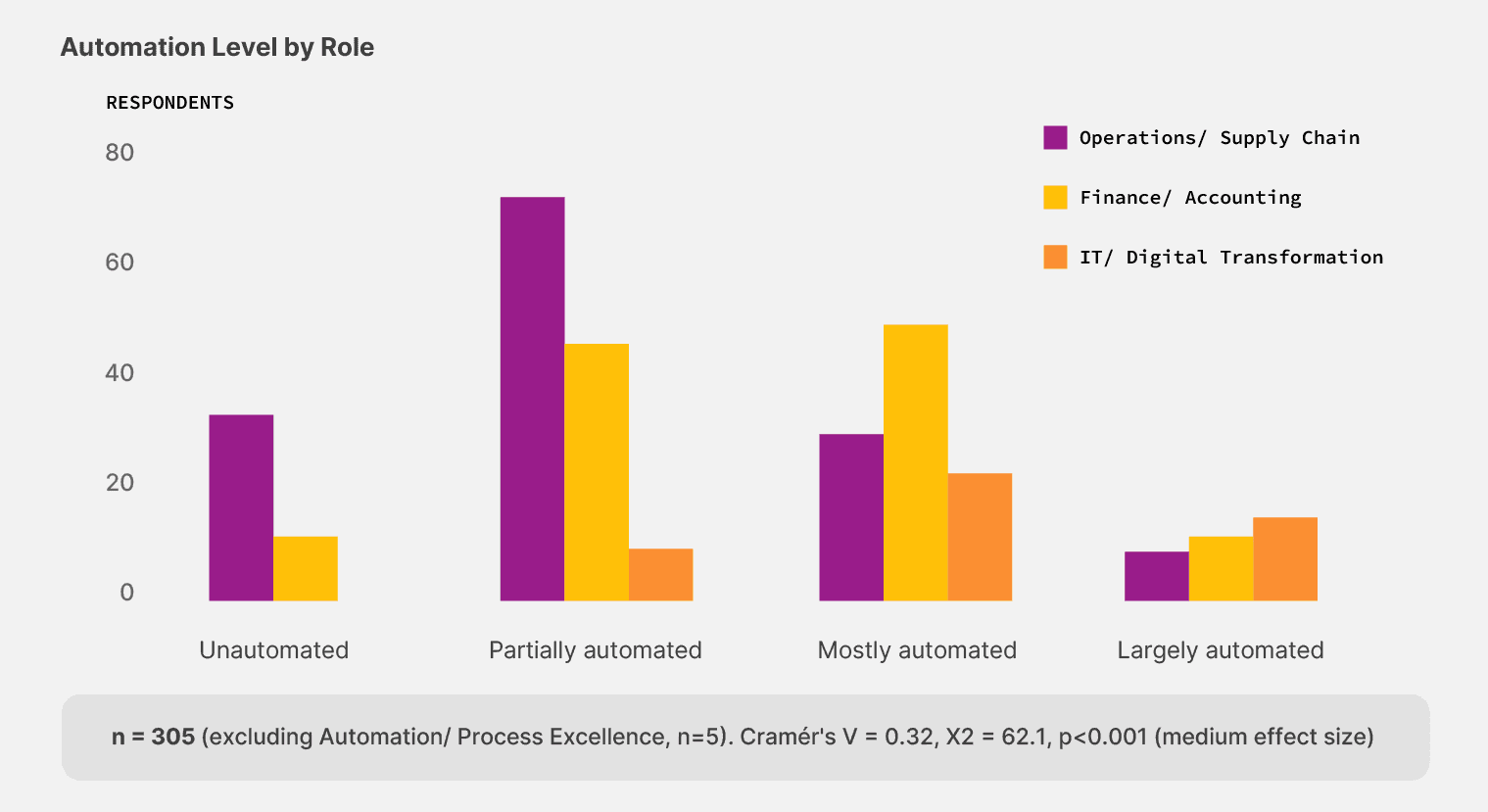
According to Docxster’s 2026 survey, the operations segment concentrates heavily at this level—23.9% of operations and supply chain leaders report being fully unautomated, compared to 14.8% across the full sample.
The move from Level 1 to Level 2: Identify your single highest-volume manual workflow and pilot one document type through an extraction tool. Docxster’s data ingestion module pulls documents from email, WhatsApp, ERPs, or manual upload, so you can centralize intake before you automate anything downstream.
Level 2: Partially automated (41.9% of teams)
This is the largest cluster in the dataset and the most expensive place to stay.
You’ve invested in some automation, but the system generates as much cleanup work as it eliminates. Workflows run until they hit a document that the system can’t parse. Then someone on your team finishes the job—usually someone you’re paying to do higher-value work, your root cause sits upstream.
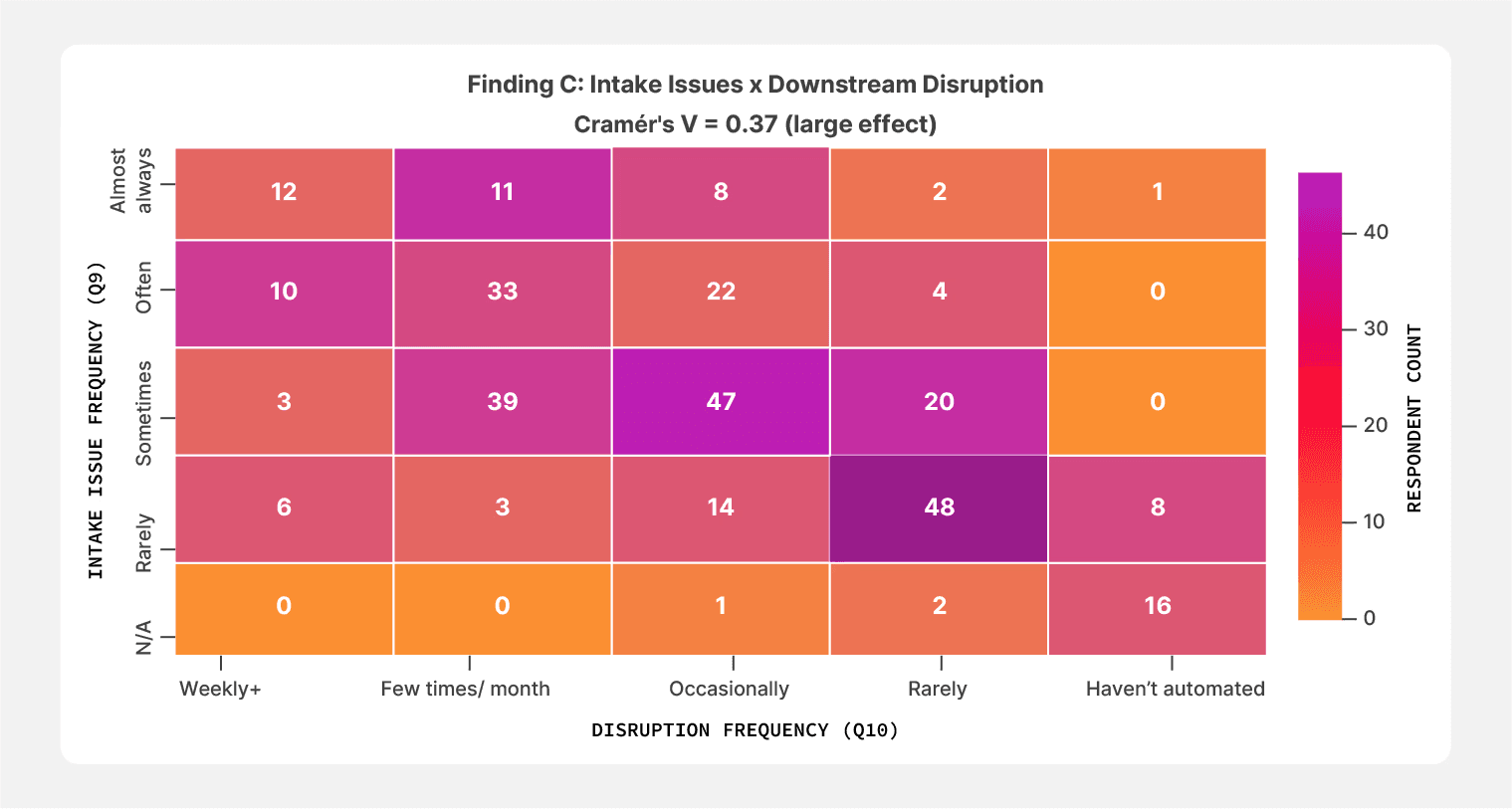
Docxster’s 2026 survey found that 68% of respondents described their document intake as unpredictable—the condition with the strongest association to downstream disruption in the entire dataset.
At Level 2, that variability hits hardest because your tools assume consistent inputs. Every new vendor format, every handwritten note scrawled on a packing slip, every invoice that arrives as a WhatsApp photo—they all break the same pipeline.
If your team sits here, you’re not behind. You’re in the same position as the plurality of the field. The question is whether your current tools can get you out or whether they’re the reason you’re stuck.
How to move from Level 2 to Level 3: Replace template-dependent OCR with templateless extraction and confidence-flagged review. You need an extraction layer that reads a document by meaning rather than by pixel position. Docxster’s templateless AI handles vendor-format variability without requiring a new template every time a carrier changes its invoice layout.
Level 3: Mostly automated (33.5% of teams)
Level 3 teams have real investment behind their automation. Documents flow through extraction pipelines, and the system handles a meaningful share of the volume.
But the review bottleneck hasn’t broken.
Your team still validates most documents—even when most extractions come back correct. It’s the equivalent of a bank manager manually counting every deposit, even after the ATM has already done it. The system works, but nobody trusts it enough to stop checking.
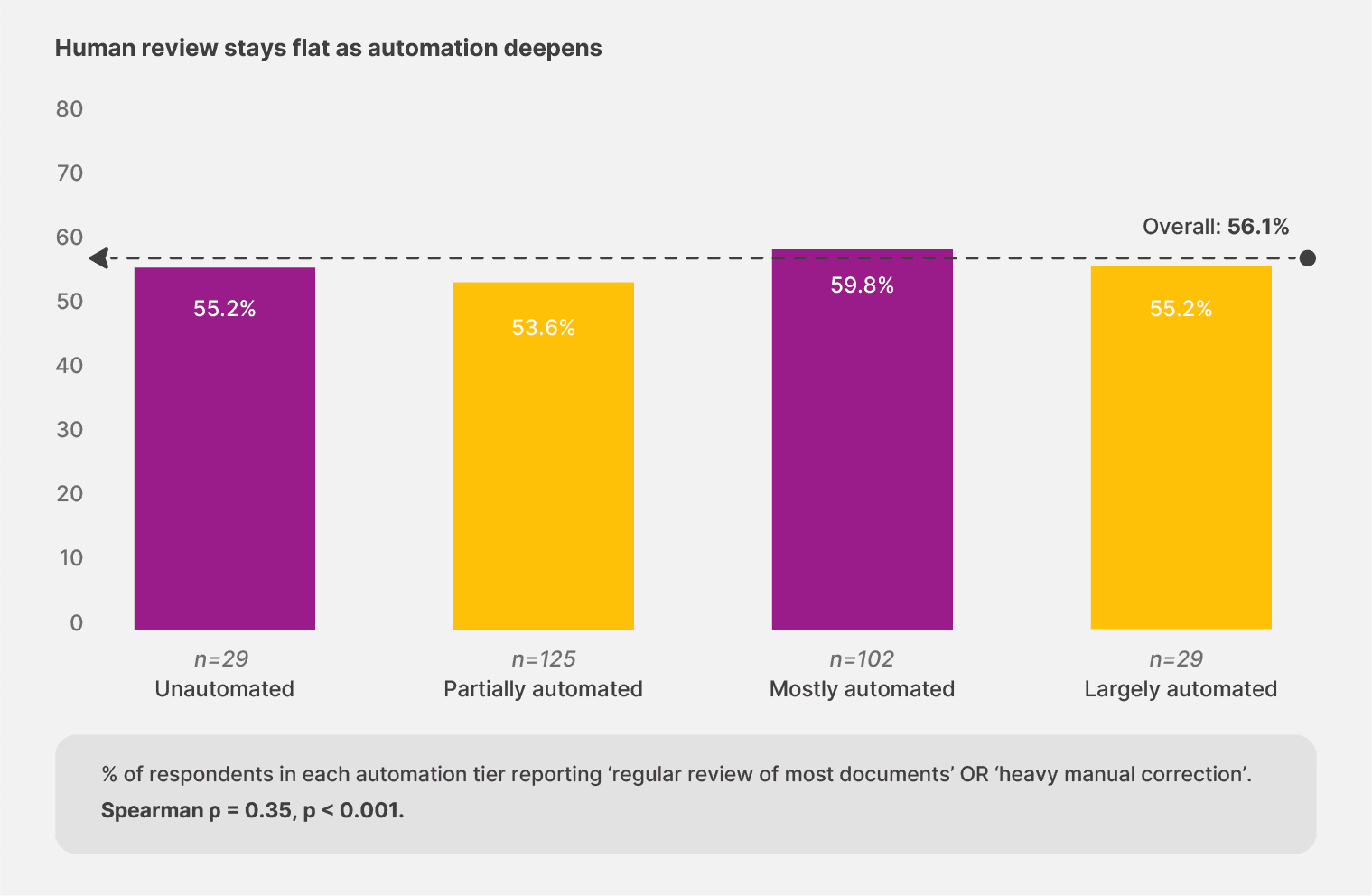
Docxster’s survey puts a number on this: 56.1% of all respondents still need regular or heavy human review, and the rate barely changes as maturity rises. Among mostly automated teams, it’s actually higher—59.8%. The current generation of tools redistributes human effort rather than eliminating it.
Finance teams cluster heavily at this level. 44.0% of finance respondents describe themselves as mostly automated, well above the 33.5% survey average. They’ve done the work. The wall they’ve hit is the document layer itself.
The move from Level 3 to Level 4: Shift from reviewing every document to sampling-based review with confidence-flagged routing. Docxster’s human-in-the-loop validation routes low-confidence outputs to a sampling queue and lets clean documents pass through untouched—so your team focuses on the 10% of cases that actually need judgment.
Level 4: Largely automated (9.7% of teams)
This is where the economics change. Your system handles 90%+ of documents end-to-end. Human review drops to spot-checking a sample. The operational cost of document processing has dropped significantly.
The pain shifts to edge cases:
Documents that don’t fit any pattern
Vendors who change formats mid-quarter
The customs declaration from a port you’ve never shipped through
The handwritten amendment on an otherwise clean PO
And here’s a counterintuitive finding from the data: trust concerns actually increase as automation maturity increases. Largely automated teams report an average of 2.13 trust concerns, well above the 1.65 reported by unautomated teams. More experience with automation means more experience with automation that failed. Teams at this level know what broken looks like because they’ve seen it.

Despite that, 40% of teams at this level want to significantly expand their automation over the next 12 months, according to Docxster’s survey. They’ve proven the model works. They want more of it.
The move from Level 4 to Level 5: You need AI that adapts to new formats without retraining, paired with human-in-the-loop validation for the long tail. Docxster’s no-code workflow builder lets your operations lead adjust routing rules the same week a vendor changes a layout—without filing an IT ticket or waiting for a developer cycle.
Level 5: Fully automated (<1% estimated)
Almost no one is here yet. The system processes 99%+ of documents end-to-end. Humans handle only true exceptions—the cases that require judgment, no algorithm can replicate.
The pain at this level is governance.
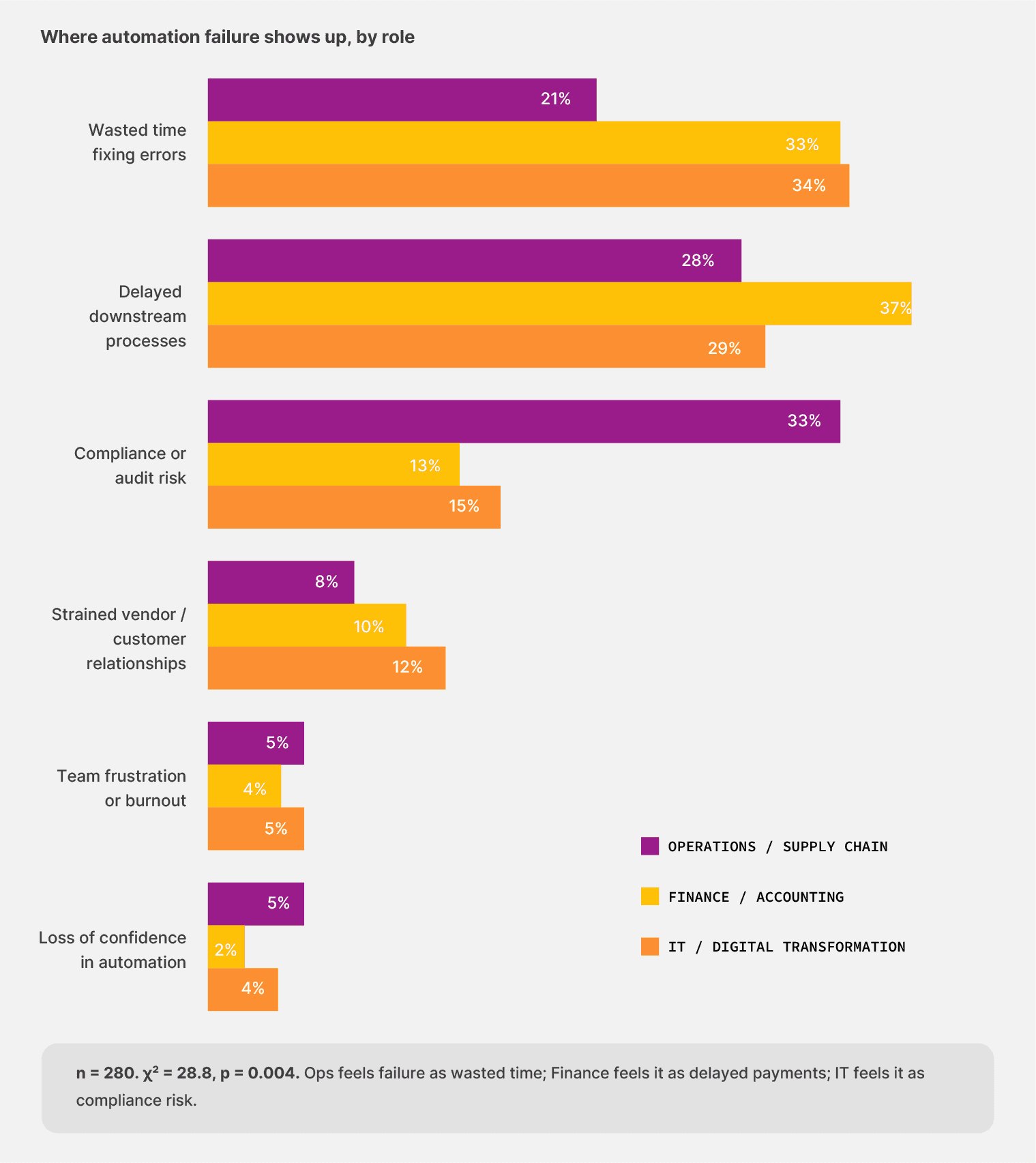
When the extraction layer works, the next challenge becomes keeping the audit trail clean, managing access controls at scale, and ensuring that what the system produces can survive an auditor’s scrutiny. Among IT respondents in Docxster’s survey, compliance and audit risk was the top failure impact at 33.3%—more than twice the rate of either operational role.
What good looks like at Level 5: Governance and audit automation become the competitive advantage. Every extracted field remains traceable from the source document to the downstream system. Every change gets logged. Finance, Operations, and IT share a common language for measuring maturity. Docxster’s full audit trail—from source document to extracted value to GL entry—supports this requirement exactly.
How DAMI was built
DAMI comes from primary research—not analyst interviews or vendor-sponsored benchmarks.
The underlying dataset draws from Docxster’s 2026 survey of 310 finance, operations, and IT leaders in document-intensive industries across the US, UK, and Canada. Centiment, an anonymous panel provider, ran the fieldwork in February 2026 and qualified respondents by role and company size before routing them to the questionnaire.
Each team’s maturity level reflects how respondents answered across six dimensions: automation level, ownership structure, intake variability, human review design, trust concerns, and 12-month outlook. Tool adoption alone doesn’t determine placement—a team with OCR but no validation queue scores differently from a team with no OCR but a tight review process.
Where comparisons reach statistical significance, chi-square, Cramér’s V, and Spearman analyses support the placement of each tier. The full methodology is published alongside the main report.
The State of No-Code Document Automation in 2026
How to use DAMI
DAMI connects to three decisions you’re likely facing right now.
Benchmarking your team. Score yourself against the five levels and see where you sit relative to the 310 teams in the dataset. The finance segment report and operations segment report offer role-specific benchmarks. If you’re a controller at a logistics company, you’re comparing against a cohort that processes the same document types under the same pressures—not against a generic automation average.
Evaluating vendors. Score every vendor against the six DAMI dimensions, not just their tool category. A vendor that supports Level 5 review patterns—confidence-flagged routing, exception-only review, traceable audit trails—delivers more value than one stuck at Level 3, regardless of how many features sit on the pricing page.
Setting internal strategy. Use DAMI to set 12-month maturity targets for your team. Moving from Level 2 to Level 3 requires solving intake variability. Moving from Level 3 to Level 4 requires redesigning your human review model. DAMI gives your team a shared vocabulary for those conversations—across Finance, Operations, and IT.
The maturity question your team can finally answer with data
Most maturity conversations die in the meeting where they're raised. The answer drifts into anecdote. The conversation moves on. Nobody leaves with a number.
DAMI changes that. The framework is public, ungated, and structured so you can cite it in an RFP, reference it in a vendor evaluation, or use it to set targets your team can actually measure against. And because it scores operational behavior rather than tool adoption, the answer holds up whether you’re talking to a procurement committee or your own leadership team.
That shifts the vendor conversation entirely. You stop asking “what does your tool do?” and start asking “what level of maturity does your tool support?” The answer tells you more than any demo ever will.
Take the DAMI interactive self-assessment to get your team’s score, or download the full State of No-Code Document Automation 2026 report to benchmark against the data.
The State of No-Code Document Automation in 2026
FAQs: DAMI Framework
What is the Document Automation Maturity Index?
The Document Automation Maturity Index, or DAMI, is a framework for measuring how mature a team’s document automation actually is. Instead of scoring teams only by which tools they use, it looks at how document workflows behave across intake, review, ownership, trust, and future automation plans.
Why was DAMI created?
DAMI was created because many existing automation maturity models are too broad, too generic, or focused on tool adoption rather than document workflow performance. The framework is designed specifically for document-heavy teams in Finance, Operations, and IT.
What are the five levels of document automation maturity?
The five DAMI levels are Manual, Partial, Mostly automated, Largely automated, and Fully automated. Each level describes how much of the document workflow runs without manual intervention, how humans review the work, and what problems teams are most likely to face.
What is Level 1 document automation maturity?
Level 1 is Manual. Teams at this stage process documents by hand, often retyping data from PDFs, emails, spreadsheets, or paper documents into downstream systems.
What is Level 2 document automation maturity?
Level 2 is Partially automated, and it is the largest group in the dataset. Teams at this level have some automation in place, but workflows still break often when documents arrive in inconsistent formats or require manual cleanup.
What is Level 3 document automation maturity?
Level 3 is Mostly automated. These teams have real automation investment in place, but they still review most documents manually because they do not yet trust the system enough to move to sampling or exception-based review.
What is Level 4 document automation maturity?
Level 4 is Largely automated. At this level, systems handle most documents end to end, while humans spot-check a sample and focus on edge cases like new vendor formats, handwritten amendments, or unusual document layouts.
What is Level 5 document automation maturity?
Level 5 is Fully automated, and almost no teams have reached it yet. At this stage, systems process nearly all documents autonomously, while humans handle only true exceptions and governance becomes the main challenge.
How can teams use DAMI?
Teams can use DAMI to benchmark their current maturity, evaluate vendors, and set practical 12-month automation goals. For example, moving from Level 2 to Level 3 usually means solving intake variability, while moving from Level 3 to Level 4 means redesigning human review.
What should teams look for in a document automation vendor?
Teams should look for vendors that support higher-maturity workflows, not just basic OCR or extraction. The article highlights capabilities like templateless extraction, confidence-based routing, exception-only review, no-code workflow changes, and traceable audit trails.
Turn documents into decisions.
See how Docxster gets you from inbox to insight in minutes, not days. Bring your toughest workflow — we'll show you what it looks like solved.


