-
10 Document Automation Statistics for Finance Teams 2026
How are finance leaders currently automating document workflows? Here’s what they’re saying and how to realistically adopt document automation in 2026.
Last updated:


TL;DR
Finance teams are ahead of other functions on document automation, but they’re still dealing with major workflow breakage.
44.0% of finance teams say their document workflows are “mostly automated,” compared with 33.5% across the broader survey.
39.4% of finance teams use document automation, OCR, or IDP tools, which means the category is already mainstream for many finance teams.
The problem is not adoption anymore; it’s document variability—changing layouts, low-quality scans, handwritten inputs, and inconsistent vendor formats.
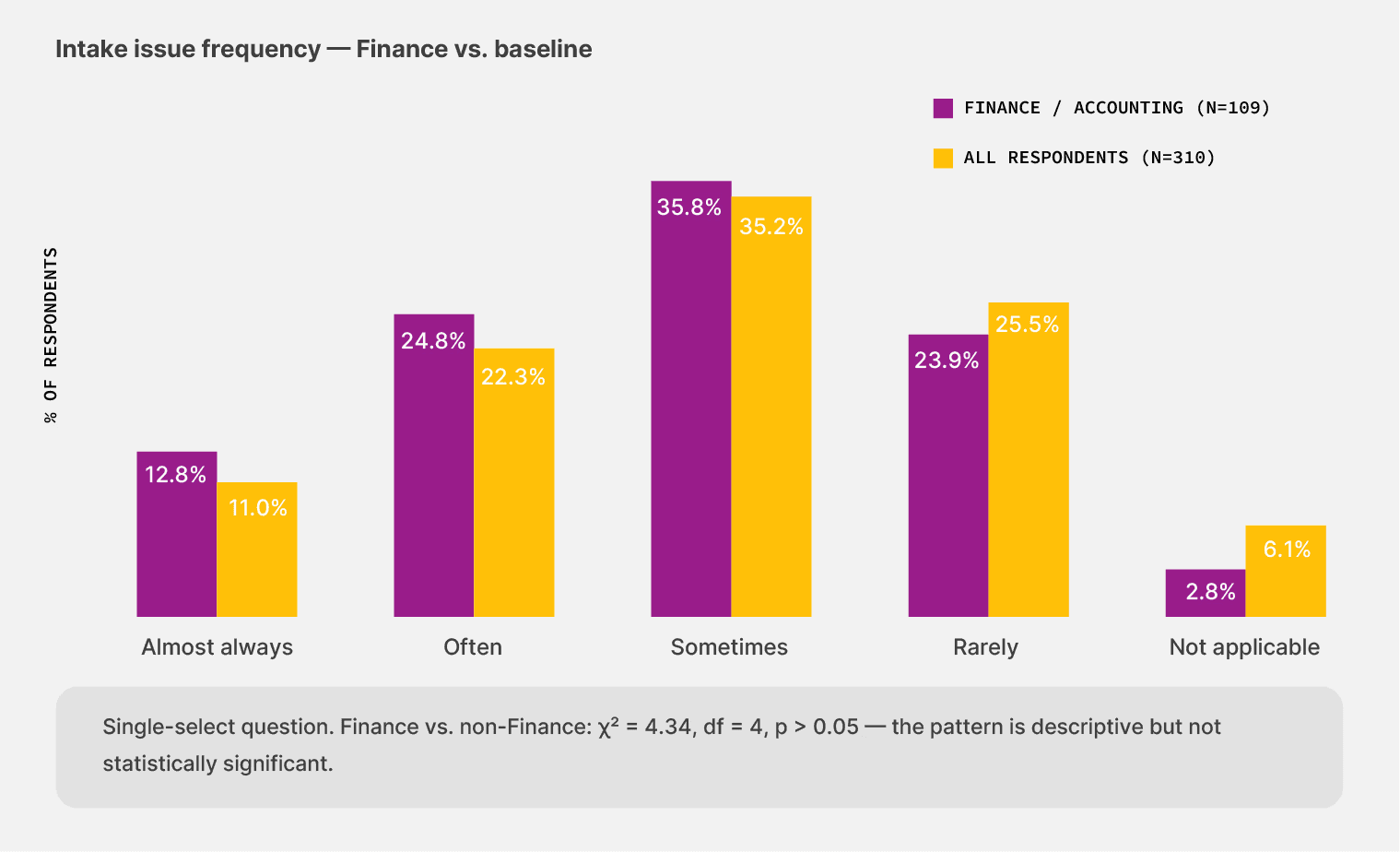
37.6% of finance teams say intake issues happen “often” or “almost always,” even though nearly all finance teams have automated some part of intake.
When automation breaks, finance pays for it in delayed payments, longer closes, missed discounts, weaker vendor relationships, and manual cleanup.
Finance teams are especially concerned about incorrect payments and whether they can trace extracted data back to the original document.
Most finance teams are not looking for a massive overhaul; 45.9% plan incremental improvements to document automation over the next 12 months.
The next generation of finance document automation needs to prove value quickly, handle messy vendor documents, and provide audit-ready traceability.
Your AP team is closing the month right now. Somewhere in that pile is a freight bill with a smudged accessorial code and a purchase order that arrived as a screenshot in a Slack message. Your optical character recognition (OCR) tool will only be able to process some of it. A controller will process the rest, probably tonight, probably after dinner.
That is the working reality for finance teams in manufacturing and logistics in 2026. And it is exactly what we set out to measure when we surveyed 310 finance, operations, and IT leaders across the US, UK, and Canada in early 2026. The finance and accounting cohort came in at 109 respondents.
In this article, we will walk through where finance teams stand on document automation today, why automation still breaks for the cohort that has invested the most in it, and what finance leaders are planning to buy in the next twelve months.
Where finance teams stand on document automation today
Finance teams have been automating invoice and PO workflows for years. The question now is not whether to start, but how far the current toolkit can actually take them. Our first three statistics show where the cohort sits on that curve, and how much investment is already behind the numbers.
#1: 44.0% of finance teams describe themselves as "mostly automated"
According to Docxster's 2026 survey of 310 finance, operations, and IT leaders, 44.0% of the finance cohort describes their document workflows as "mostly automated." The same figure runs at 33.5% across the broader survey, a gap of roughly 10% points.

If you head a finance team in a manufacturing or logistics company, you’re about a third more likely than your operations or IT counterparts to sit at the upper end of the maturity scale. Your team is past the starting line. Whatever conversation is happening inside the function about document automation, it’s no longer the "should we start" conversation. You’ve moved on to the "Why is the next layer so hard" conversation.
#2: 39.4% of finance teams have adopted document automation, OCR, or IDP tools
The same survey shows that 39.4% of finance teams now use document automation, OCR, or intelligent document processing (IDP) tools, compared with 33.5% across the broader sample. Finance also runs cleaner tool inventories: only 4.6% of finance respondents say they are unsure what sits in their stack, against 9.0% in the broader survey.
This means finance has invested more in document-specific automation than the average team. The category is no longer experimental for them. It also means that any further investment has to clear a higher bar, because the easy gains from the first round of OCR adoption have already been booked.
#3: 97.2% of finance teams have automated some part of their document intake
Across the finance cohort, 97.2% have automated some part of their document intake, compared with 93.9% in the broader survey. Only 2.8% of finance teams say intake automation doesn’t apply to their work, against 6.1% across the broader survey.
This means the automation footprint inside finance is almost universal. The cohort isn’t debating whether to bring automation to the front door of the workflow—they’ve already done it. This makes the next set of numbers more interesting, because the teams that have automated the most are the same teams reporting the most variability in document intake.
Why document automation breaks for finance teams
Finance’s investment in document automation hasn’t yet led to a quiet workflow. The next four statistics show what still breaks once intake is automated, and who absorbs the cost when it does.
#4: 37.6% of finance teams say document intake issues hit "often" or "almost always"
Across the finance cohort, 37.6% report intake issues happening "often" or "almost always," compared with 33.3% across the broader survey. A higher share, 12.8%, puts it at "almost always," against 11.0% in the broader sample.
This means more automation also means more visibility into breakage. Finance has automated more intake than the average team, so they see more of what intake automation breaks on. Three specific document challenges hit this cohort harder than the rest of the field:
Frequent layout changes (32.1% vs. 24.2% in the broader survey)
Handwritten or low-quality scans (38.5% vs. 33.5%)
Difficulty validating extracted data
Vendors decide the format of their own invoices, and every new vendor adds a tax to the existing setup.
#5: 74.3% of finance teams face at least occasional document workflow disruptions
In our survey, we also found that 74.3% of finance teams face at least occasional disruptions to their document workflows. As a whole, the survey’s baseline runs at 67.4%.
This means disruption isn't an occasional emergency for finance teams—it's a recurring part of how the work runs. A few unpredictable batches a month are enough to slow everything queued behind them, and the delay carries into payment timing and month-end closes.
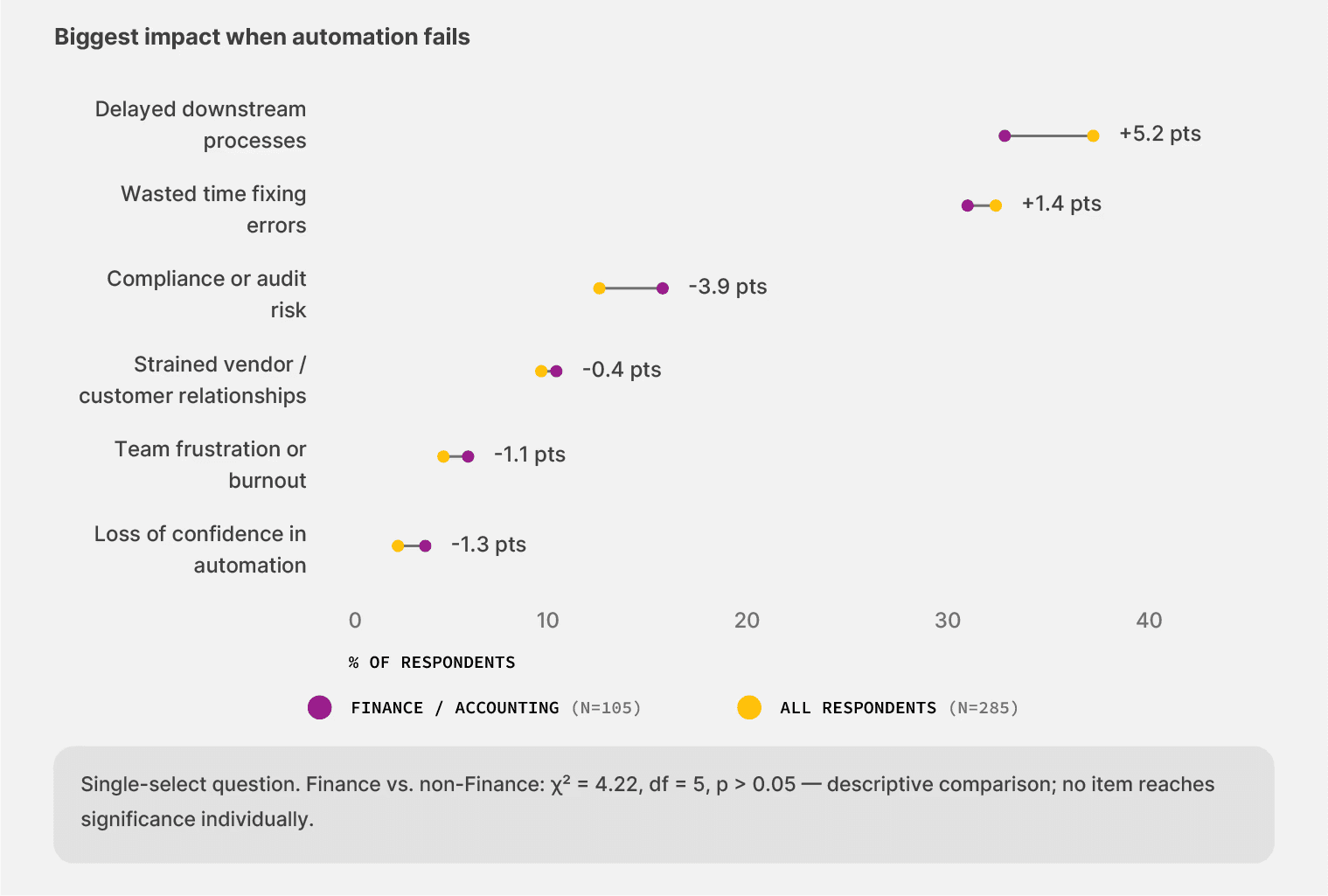
#6: 37.1% of finance teams name delayed downstream processes as the highest cost when automation fails
Among finance teams, 37.1% name delayed downstream processes as the top consequence when automation fails. The baseline runs at 31.9%.
Inside a finance team, this problem usually means these four things:
Late payments to vendors past 2/10 net 30 terms, which cost real money in lost early-payment discounts.
Vendor relationships that erode over time, especially with strategic suppliers who notice when the same delays repeat.
Cash flow visibility problems, where the controller cannot tell what is actually outstanding versus what is stuck in a workflow exception queue.
A longer month-end close that runs an extra day or two because reconciliations are still in flight.
Whatever “delayed downstream” means inside your team, it shows up as a steady drag on the work the function is actually paid to do. The hours your AP lead loses chasing an exception are hours not spent on vendor strategy or close support. The discount you forfeit on a 2/10 net 30 invoice is a lost margin because of a workflow problem, not a vendor problem.
#7: 33.3% of finance teams say business users manually fix the data when automation breaks
Among finance teams, 33.3% say business users manually fix the data when automation breaks, against 27.4% in the broader survey. At the same time, finance teams are about five points less likely than the baseline to get IT to step in (24.8% vs. 29.8%).
When extraction fails, the work goes back to the AP team. That is the logical place for it because the AP lead is the one who knows the vendor and can spot a wrong line item without a second pair of eyes. But it also means your senior accountants and controllers are spending hours on retyping that should be going to close support, analysis, or vendor strategy. When manual cleanup lands on the team that owns the documents, you pay for both the tool and the cleanup.
What finance teams want from the next generation of document automation
Finance teams have a clear picture of what the next tool needs to do. The last three statistics show what they are looking for in an extraction layer, the review model they have settled on, and how they plan to buy.
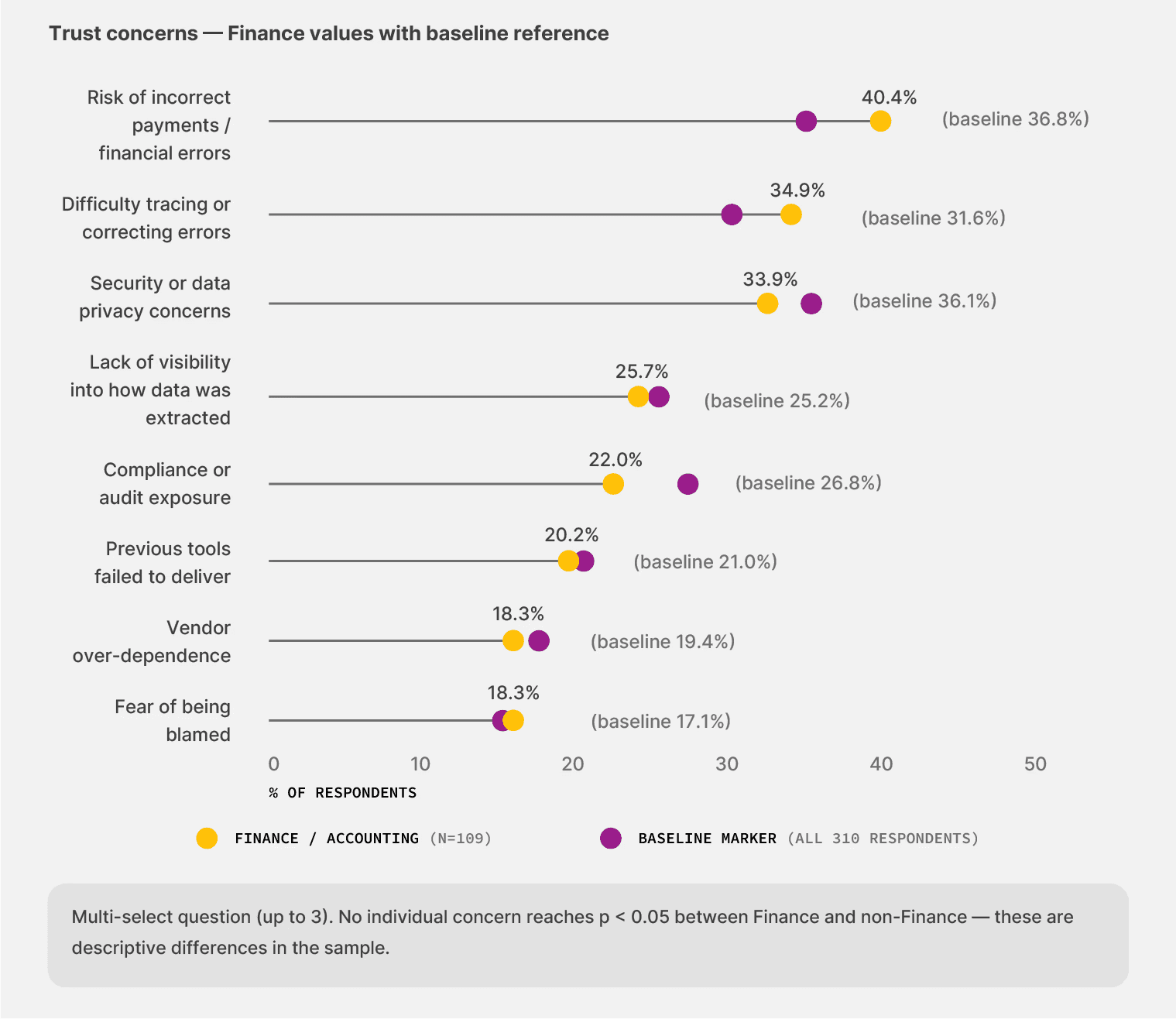
#8: 40.4% of finance teams name the risk of incorrect payments as their top trust concern
Among finance teams, 40.4% name "risk of incorrect payments or financial errors" as a top trust concern for document automation. The baseline rate across the broader survey runs at 36.8%. A close second is the verification problem: 34.9% of finance teams name "difficulty tracing or correcting errors" as a top concern, against 31.6% in the baseline.
For finance leaders, the failure that matters most is the simplest one: paying the wrong amount.
A wrong number on a payment lands harder than abstract regulatory exposure. (Compliance comes in lower for the cohort than for the baseline, at 22.0% vs. 26.8%.)
This shapes what to look for in your next tool: can it show where every number came from? Your team should be able to trace any extracted figure back to the exact spot on the original document, for their own peace of mind and for the auditor. A tool that can't do that isn't worth much, however accurate it claims to be.
#9: 45.7% of finance teams use a "light review" model
Light review, or spot-checking, lands at 45.7% for the finance cohort, against 38.6% in the baseline. Reviewing most documents in full is less common in finance, at 43.8%, down from 50.5% in the broader survey.
This means finance has already worked out how it wants to handle human review: sample a portion of documents instead of checking every one. That's exactly the stage where the right tool pays off most.
These teams trust the system enough to spot-check, but they won't go fully hands-off until they can confirm the work is right. What they need is a way to point human attention to the small share of cases that actually need it, rather than at every line of every invoice.
#10: 45.9% of finance teams plan incremental improvements to document automation in the next 12 months
Looking ahead, 45.9% of finance teams plan incremental improvements over the next 12 months, about 4 to 5% points above the baseline rate of 41.3%. Active "replace" mode sits at 17.4%, about five points below the baseline (21.3%). Only 1.8% plan to pause or scale back, against 3.2% in the broader sample.
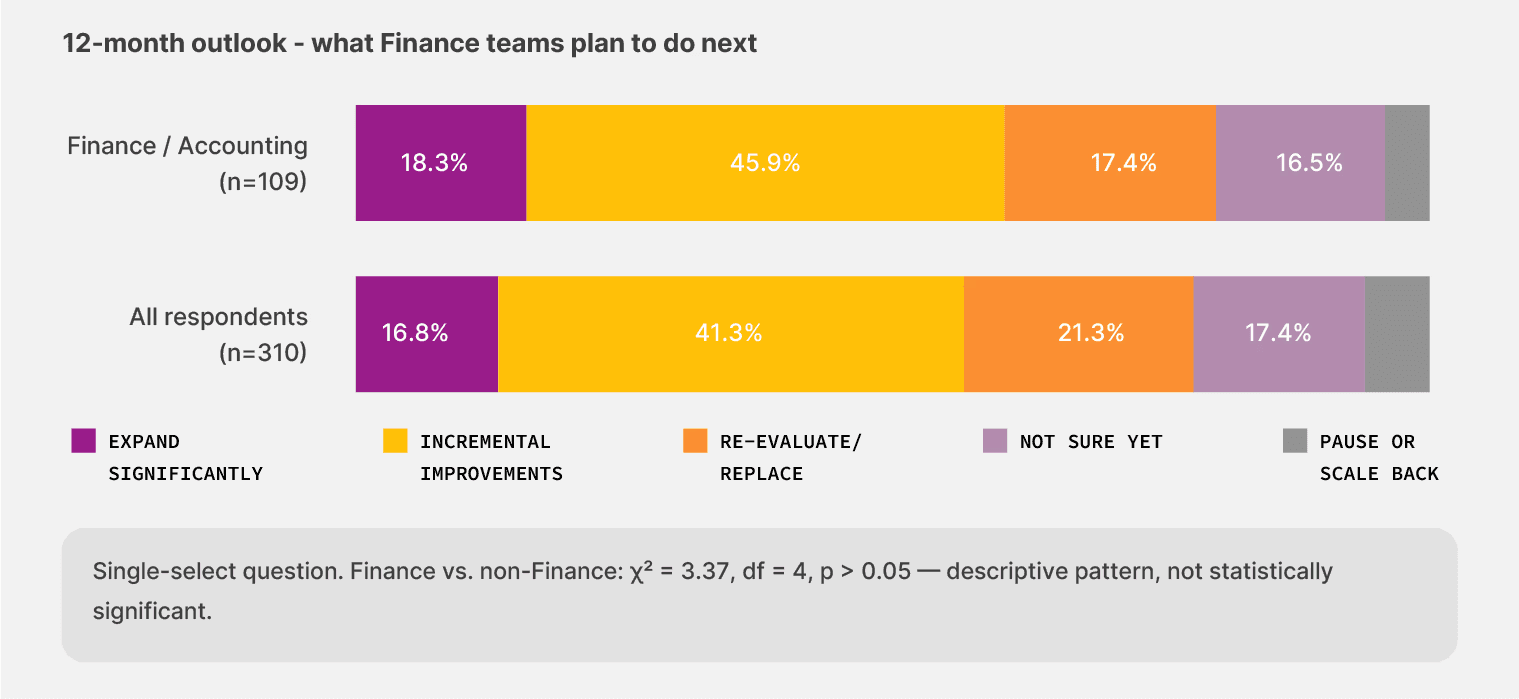
This means finance teams buy carefully. They favor small, proven pilots over sweeping system overhauls. That pattern holds beyond document automation—it’s just how finance buys..
What finance teams actually want to know is whether a vendor can prove value in one workflow within 60 days, with an audit trail that a CFO and an external auditor would both accept. If yes, the next workflow follows. If no, the team has spent 60 days on one workflow rather than 18 months in a transformation program.
The wall isn’t the tools—it’s the documents
Finance teams have done the work. They've invested in better tools and automated more of their intake than the rest of the field. The problem now isn't the tool category. It's that the current tools were never built for what finance actually receives: layouts that keep changing, handwritten scans, and vendor formats that vary from one supplier to the next.
The data shows where finance is heading next. Most teams are planning incremental improvements over the next year rather than full replacements of their current tools. What they want is a software that can prove its value in one workflow before they expand it to the next.
If you want the full analysis behind these ten statistics, including the charts and statistical-significance disclosures, you can download the finance segment report here:
State of No-Code Document Automation Report 2026: Finance Segment
FAQs: Document Automation for Finance
What is document automation for finance teams?
Document automation for finance teams is the use of software to capture, extract, validate, and route information from financial documents like invoices, purchase orders, freight bills, and receipts. The goal is to reduce manual data entry, speed up approvals, and make processes like accounts payable and month-end close more reliable.
Why do finance teams need document automation?
Finance teams handle high volumes of documents that often arrive in inconsistent formats, especially in industries like manufacturing and logistics. Automation helps reduce repetitive work, but the article shows that many teams still struggle when documents are messy, scanned, handwritten, or formatted differently by each vendor.
How automated are finance document workflows in 2026?
44.0% of finance teams describe their document workflows as “mostly automated.” That puts finance ahead of the broader survey average, but it also shows that many teams are still working through the harder layers of automation.
What types of tools are finance teams using for document automation?
Finance teams commonly use document automation, OCR, and intelligent document processing tools. 39.4% of finance teams have adopted one of these tools, compared with 33.5% across the broader respondent base.
Why does document automation still break for finance teams?
It often breaks because real finance documents are inconsistent. Vendor invoice layouts change, scans are low quality, handwriting may be involved, and extracted data can be hard to validate; recent OCR and financial-document research also points to variable layouts and poor scan quality as persistent extraction challenges.
What happens when finance document automation fails?
When automation fails, the biggest cost is often downstream delay. 37.1% of finance teams name delayed downstream processes as the highest cost, which can affect vendor payments, cash visibility, and month-end close timelines.
Who fixes errors when finance automation breaks?
In many cases, the work goes back to business users rather than IT. 33.3% of finance teams report that business users manually fix the data when automation breaks, which means AP staff, accountants, or controllers often absorb the cleanup work.
What is the biggest trust concern for finance teams using document automation?
The biggest trust concern is the risk of incorrect payments or financial errors. 40.4% of finance teams name this as a top concern, which is why traceability and audit-ready evidence matter so much in finance automation.
Should finance teams fully automate document review?
Not always. Many finance teams prefer a light review model, where humans spot-check documents instead of reviewing every item in full; 45.7% of finance teams use this approach.
What should finance leaders look for in their next document automation tool?
Finance leaders should look for tools that can handle changing vendor formats, flag uncertain cases, and show exactly where every extracted value came from. Auditability is becoming especially important as finance teams adopt more AI-enabled automation and governance expectations rise.
Turn documents into decisions.
See how Docxster gets you from inbox to insight in minutes, not days. Bring your toughest workflow — we'll show you what it looks like solved.


