-
What Is HTS Classification and How to Automate It
Learn what HTS classification is, why it matters for customs entries, and how document automation helps brokers classify each line accurately at intake.
Last updated:



As a broker you might know the tariff schedule well and still assign the wrong HTS classification number, usually because of the incomplete documentation. It could be a vague description, missing information or incorrect information. Whatever the reason maybe, the load falls back on the customs broker.
You have to sit and search for this information and eventually do the tedious task of classifying the HTS tariff classification code. We've created this guide to help you understand what HTS classification is and how customs brokers can use document automation to make HTS classification easier for them.
What is HTS classification
The Harmonized Tariff Schedule of the United States (HTS) sets the duty rate and statistical category for every good imported into the country. The US International Trade Commission publishes and maintains it, and CBP administers it at the port of entry. HTS classification is the work of assigning each line on an entry to one 10-digit number from that schedule, based on what the product is made of and how it is used.
The code is built in layers, and each layer narrows the product:
Digits 1–2 (chapter): the broad category. Chapter 61 covers knitted or crocheted apparel.
Digits 1–4 (heading): a group within the chapter. Heading 6109 covers T-shirts and similar knitted garments.
Digits 1–6 (subheading): the international level shared by every country on the Harmonized System. 6109.10 is the cotton version.
Digits 1–8 (US subheading): where the duty rate is set and where the legal text ends. 6109.10.00 carries the rate.
Digits 1–10 (statistical suffix): the two digits the US adds for trade data. 6109.10.00.04 is one suffix under that line.
The first six digits are the same worldwide, and the US adds the last four. What separates one suffix from the next is often a single attribute: 6109.10.00.04 covers all-white cotton T-shirts with no pockets or trim, so the same shirt in a color reports under a different code.
Why HTS codes matter in U.S. customs entries
The 10-digit code you assign to a line does more than set the duty rate. It is the field CBP and the partner government agencies read to decide what the entry has to contain and whether the goods can come in at all. One US HTS classification controls several outcomes at once:
Duty owed: The rate attaches at the 8-digit level, whether it is an ad valorem percentage, a specific rate per unit, or a compound of the two.
Trade remedy duties: Section 301 and Section 232 duties are reported through Chapter 99 subheadings that sit on the same entry line as the base classification, so the code decides whether those added duties apply. Antidumping and countervailing duties turn on whether the product falls within a scope written against specific HTS provisions.
PGA requirements: The HTS tariff classification line is the primary selector for partner government agency data in ACE. When a line carries a flag for an agency such as the FDA or EPA, the filer has to supply that agency's data set or an approved disclaimer, or the entry gets held.
Preference eligibility: A USMCA or CAFTA-DR claim is made against a specific HTS classification number, so the code and the origin together decide whether the goods qualify for a reduced or free rate.
Admissibility: Restricted and prohibited goods are identified by their classification, which is what routes them to the agency that controls their entry.
Under 19 U.S.C. §1484, the importer of record has to use reasonable care to classify and value the goods it enters, and CBP makes the final call on classification. As the party that actually prepares the entry, you are bound by your own duty of responsible supervision and control under 19 CFR Part 111, so importer-supplied data does not move that responsibility off your desk.
The cost of a wrong HTS code
The cost of a wrong HTS classification number runs in both directions. Underpaying duty exposes the importer to penalties and interest under 19 U.S.C. §1592, which reach further when CBP finds negligence rather than an honest error. Overpaying draws no penalty, but the client absorbs duty it never owed and holds the brokerage responsible once it surfaces.
The problems with classifying HTS codes for U.S. custom brokers
1. Vague or incomplete product descriptions
A commercial invoice is written to move freight and bill the buyer, not to classify goods. The product line usually reads as commercial shorthand, "steel parts" or "plastic fittings," which works for the warehouse but tells you almost nothing about the HTS classification number to assign.
During our demo calls, one broker said: "Importers and exporters don't provide proper paperwork. Their invoices are most of the time incomplete, or the descriptions are very generic. Steel parts? What steel part? It could be a million things. Automotive alone has a million parts."
This vague and incomplete nature of descriptions becomes a problem for a broker trying to classify the HTS tariff classification codes.
2. Inconsistent data across documents
HTS classification doesn't start from a single document. The invoice, the packing list, and the purchase order all describe the same shipment, and they often describe it differently. One lists a product name, another uses the supplier's part number, and a third has a description that matches neither.
Before you can assign a HTS classification number, you have to determine which description is correct. That means reading across all three documents and checking them against each other manually.
Customs brokers have described this issue consistently over our demo calls. One of them said: "There are times where we need to compare the weight of the shipment from what's on the bill of lading to what's on an invoice or a packing list."
The broker's example is weight, but the same applies to any detail that differs across documents. When the invoice and the packing list don’t match, you have to find out which one is right before you can classify from it.
3. Time pressure vs. classification complexity
A defensible US HTS classification takes research. For anything that isn't routine, you work through the General Rules of Interpretation, check the CROSS database for CBP rulings on similar goods, and review the Explanatory Notes and your own prior classifications. That takes time on every line.
The problem is that there usually isn't time for it. Entries are often due the same day or the next day, and a shipment already at the airport has to be released quickly.
During our demo calls, one broker said: "The way our emails come in, we're doing things quickly, on pace. Someone's at the airport and they need shipments done now."
Volume adds to the problem. At month-end and during peak season, the same deadline applies to many more entries at once.
4. Manual and fragmented workflows
The documents you need arrive in different formats. Some come as PDFs, some as email attachments, and some as EDI files, and each one has to be opened and read on its own. There is no single place where all the shipment data comes in ready to use.
From there, the data is entered manually. Someone reads the invoice and keys the details into a classification tool, then into the ABI/ACE system. Each time the same information is retyped, there is another chance to introduce an error.
Customs brokers during our demo calls felt the same: "A series of different carriers send in PDF attachments, pretty much exclusively PDFs. The mail comes in, the release analyst opens the PDF, and then from that PDF types the relevant information into the system."
How document automation fixes HTS classification problems
1. Structured data extraction from day one
Manual entry work starts with the documents. They arrive as files someone has to open and read, and the filing system can't use the data until it's typed in by hand.
Document automation reads the files as they arrive and extracts the data, so the entry writer starts from structured fields instead of a raw PDF.
Docxster does this at intake. It reads invoices, packing lists, and purchase orders in any format they come in: PDF, scanned document, EDI file, or email attachment. From each one it pulls the line-item descriptions that drive classification, along with the fields the entry needs like quantity, value, and country of origin.
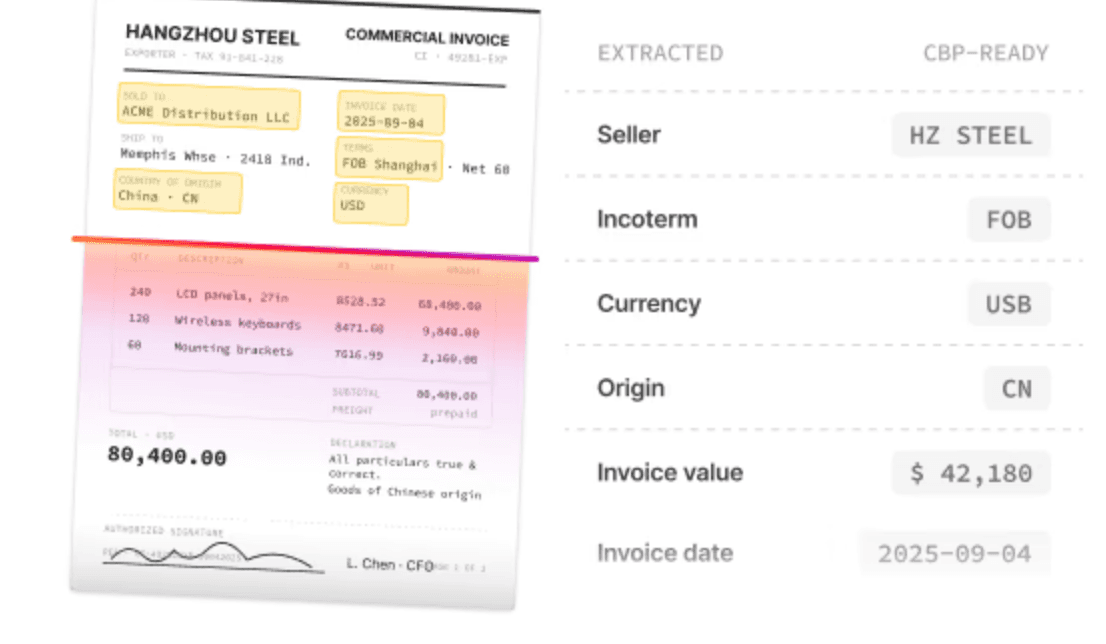
An image showing Docxster’s templateless extraction
It works without per-supplier templates or manual field mapping. A new carrier can send an invoice in a layout Docxster hasn't seen before, and the fields come out of that first document, with no template to build beforehand.
The entry writer then opens an entry that's already parsed. Instead of reading a PDF and re-keying it, they have the descriptions and fields in front of them and go straight to the HTS tariff classification code.
2. Description validation at intake
The best time to catch a vague description is at intake, before it reaches the entry writer. At that point there's still time to get the missing detail without holding up the entry.
Docxster checks descriptions as the documents come in and flags any that are missing the attributes classification needs, like material, function, or end use. For a flagged line, it sends the shipper a form requesting the specific details that are missing, and the information they submit is added straight into the entry.
So a vague description like "steel parts" gets caught at intake, not when the entry writer is already assigning the HTS classification number. By the time the entry reaches them, the gaps are filled and they're working from complete data.
3. Embedded HTS classification engines
Docxster suggests an HTS code for each line in the same system that reads the documents, so the entry writer classifies in the same place, without opening a separate tool.
It checks the broker's existing parts library first. A product you've classified before gets the same code you gave it last time, which keeps classification consistent across shipments and across whoever is handling the entry.
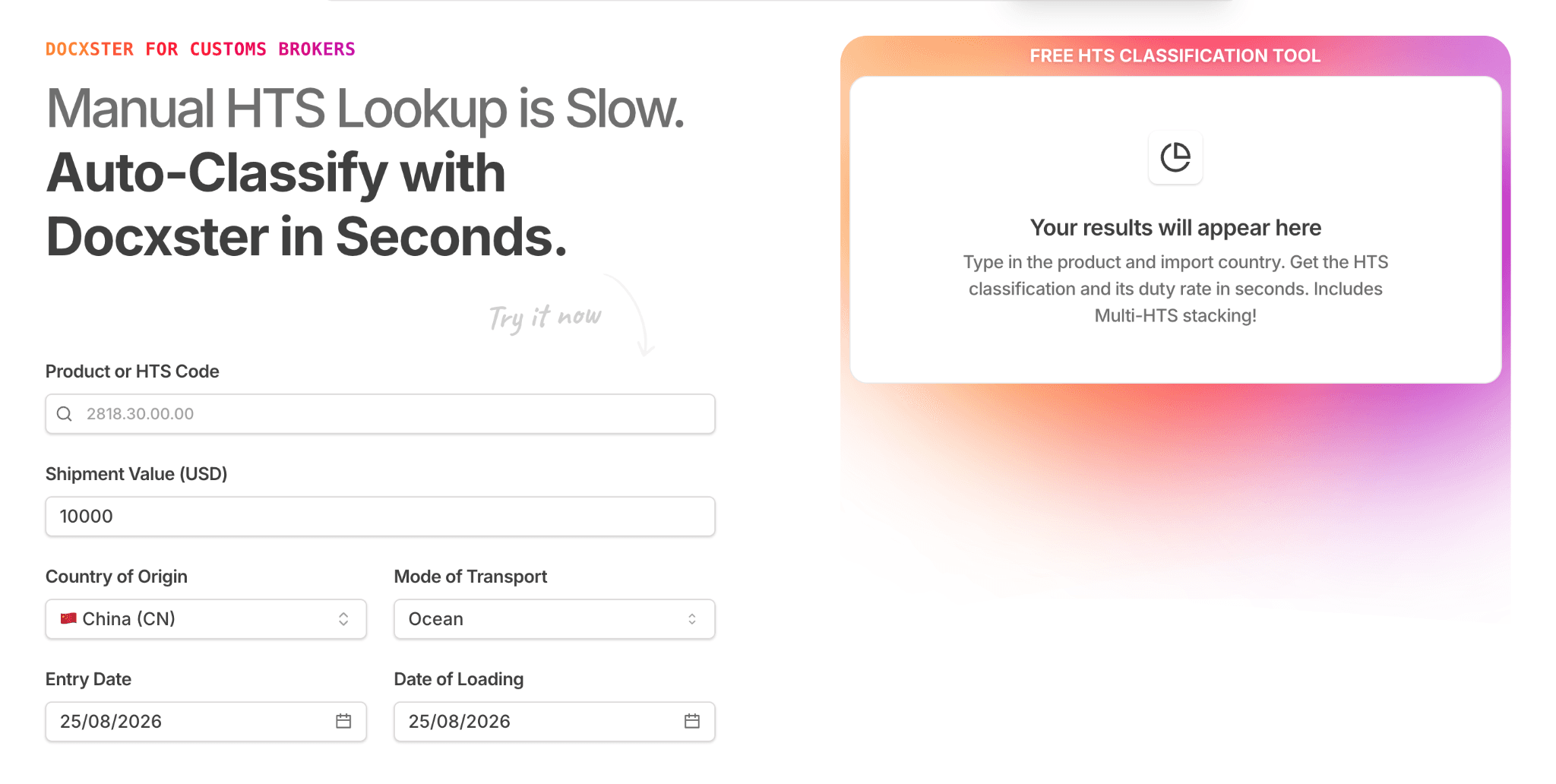
An image showing Docxster’s free HTS tariff classification tool
When there's no match in the library, Docxster suggests a code from the extracted product description. Each suggestion comes with a confidence score and with supporting precedents from CBP rulings and the Explanatory Notes, so the reasoning behind the code is there to check rather than something to research from scratch.
The reviewer confirms or changes each code. The final classification stays with the broker, but starts from a suggestion and its precedents instead of a blank line.
4. Integration with entry systems
Once the entry writer confirms a classification, the line is ready to move into the filing software the brokerage already uses.Docxster integrates with the platforms brokers already file in, including CargoWise, NetCHB, and SAP, so the validated entry data goes straight from Docxster into the software you use to file.
Each line keeps its own record. The original invoice description stays attached to the confirmed HTS classification number and the precedents behind it, so if the entry is ever questioned, the reasoning is already documented.
The entry writer spends less time on data entry and more on the classifications that actually need judgment.
Choosing software that catches a bad description before it reaches the code
Most HTS classification errors don't come from misreading the tariff schedule. They come from the documents that sit upstream.
A lot of time also goes into work that isn't related to HTS classification, like reading a new invoice format or collecting missing information. If all of this happens at intake, before the data reaches your filing software, what is left for you is the code classification and the declaration.
Docxster does that upstream step for customs brokers. Our platform reads the documents, extracts each line, and our free HTS tool suggests a code for every one. The HTS classifier can also be integrated within your workflow to keep getting HTS code suggestions as you extract customs entry data. You still confirm each code, so the final call stays yours.
Book a demo to see it run on your own invoices
FAQs
Who is responsible for HTS classification, the customs broker or the importer?
The importer of record carries the legal duty under 19 U.S.C. §1484, but the broker preparing the entry is bound by its own reasonable-care obligation and can't simply file the code an importer provides. CBP makes the final call on classification.
What happens if a product is classified under the wrong HTS code?
A wrong code changes the duty owed and can expose the importer to penalties under 19 U.S.C. §1592 if CBP finds negligence. It can also hold the shipment when the code triggers a PGA requirement the entry can't meet.
Why do vague product descriptions cause HTS misclassifications?
The HTS code is assigned from the product description. When the description leaves out details like the item's function or end use, there isn't enough information to reach the correct code.
Does automated HTS classification replace the broker's judgment?
No. The system suggests a code with its supporting rulings, but the broker confirms or changes each one, so the final classification stays with them.
Is automated HTS classification compliant with CBP requirements?
Yes. CBP requires reasonable care in how a code is determined, not a specific method, and automation supports that by keeping a record of how each code was reached while the broker makes the final decision.
Turn documents into decisions.
See how Docxster gets you from inbox to insight in minutes, not days. Bring your toughest workflow — we'll show you what it looks like solved.


