-
10 Document Automation Statistics for Operations in 2026
How are operation leaders currently automating document workflows? Here’s what they’re saying and how to realistically adopt document automation in 2026.
Last updated:


TL;DR
Operations teams handle some of the most document-heavy workflows, but they have the least automation in place.
73.5% of Operations teams describe their document workflows as partially automated or worse.
Nearly a quarter of Operations teams, 23.9%, still process documents fully manually from end to end.
Only 24.5% of Operations teams use document automation, OCR, or IDP tools, even though these tools are highly relevant to freight bills, BOLs, customs forms, and POs.
Operations teams are also less likely to use no-code tools, with only 9.7% reporting adoption.
When automation breaks, Operations teams are more likely than average to fall back to manual handling.
Some failures go unnoticed until they cause downstream damage, such as missed shipments, duplicate payments, or customs issues.
The opportunity is large: 57.4% of Operations teams that automate see meaningful value within 60 days.
Operations teams are the most ready to switch, with 44.5% either actively replacing tools or open to change in the next 12 months.
The main need is clear: Operations teams want document automation they can set up, monitor, and adjust without depending heavily on IT.
Operations teams work with more documents than any other function. A single shipment can involve a bill of lading, a freight bill, a customs form, and a purchase order. Each one is formatted differently, and each comes from a different sender. Yet these teams have less automation in place than anyone else.
We wanted to understand how wide that gap is. In early 2026, we surveyed 310 finance, operations, and IT leaders across the US, UK, and Canada. Operations and supply chain leaders made up the largest group, at 155 people.
The resulting findings point to something useful. The teams doing the most manual work are also the ones who benefit the fastest when they automate. They are also the most willing to make that change. These ten statistics show where operations teams stand today, why many are still stuck, and why that’s beginning to change.
Where Operations teams stand on document automation today
These first three numbers show how much of the work is automated and what tools operations teams are using:
#1: 73.5% of Operations teams sit at "partially automated or worse"
According to Docxster's 2026 survey of 310 finance, operations, and IT leaders, 73.5% of Operations teams describe their document workflows as partially automated or worse. The same figure runs at 56.8% across the broader survey, a gap of roughly 17 percentage points. Across all segments, no group diverged further from the average than this one.
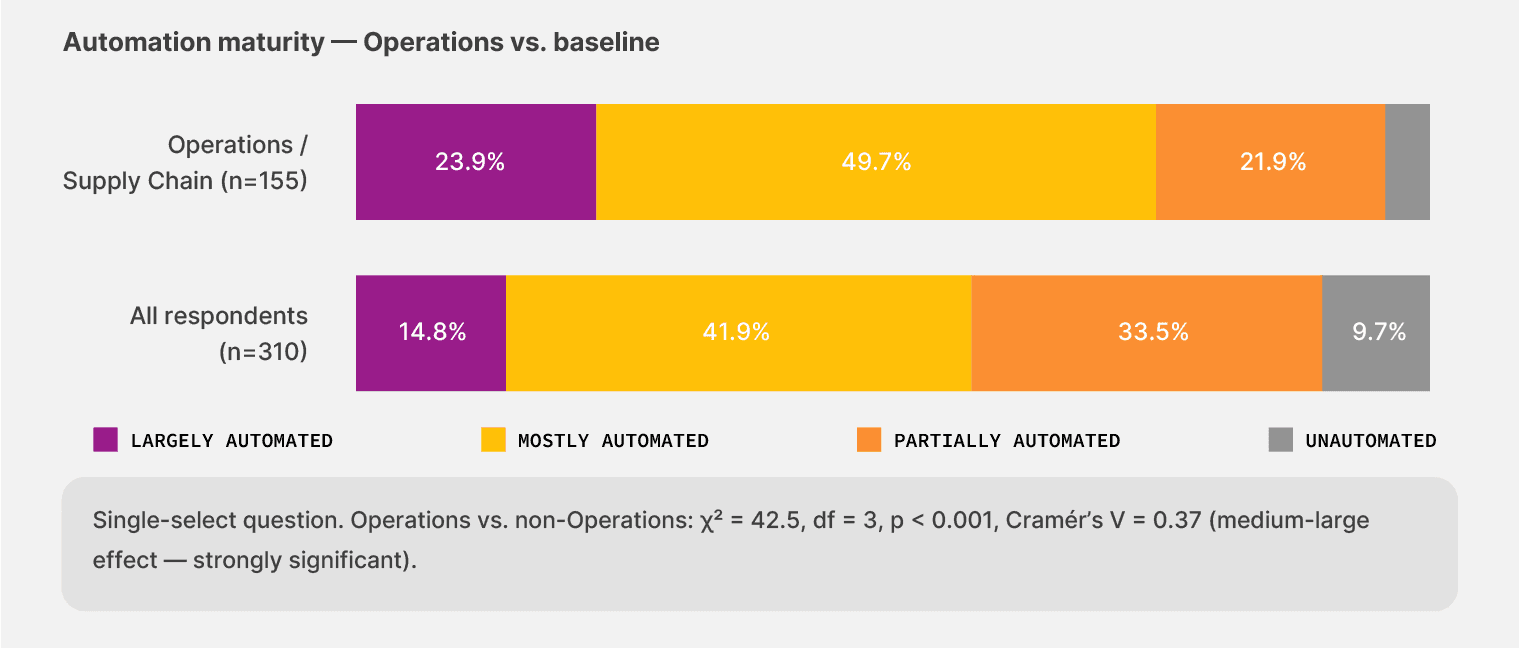
Operations is roughly a third more likely than the average team to be running on stitched-together automation. The gap itself is the headline. If you run an Ops team in manufacturing or logistics, the conversation in your function isn’t "Why aren't we automated yet?" It’s "Why is our automation this brittle?" You’re not behind your IT counterparts because your team is slow to adopt. You’re behind because the category was built for someone else's document load.
#2: 23.9% of Operations teams haven’t automated their document workflows
Across the Operations cohort, 23.9% describe their document workflows as fully manual, compared with 14.8% across the broader survey. Almost a quarter of the cohort still processes BOLs, freight bills, and POs by hand from end to end.
The starting line for many Operations teams is still typing. Ops is more than half as likely as the average team in the survey to be doing document work entirely by hand. That baseline also shapes what comes later: the further a team starts from automation, the sharper the impact when it arrives.
#3: Only 24.5% of Operations teams have adopted document automation, OCR, or IDP tools
The same survey shows that 24.5% of Operations teams use document automation, optical character recognition (OCR), or intelligent document processing (IDP) tools, against 33.5% across the broader sample. That’s a 9-point gap in the tool category that matters most to Operations work. RPA adoption runs lower too, at 7.7% in Ops against 14.5% across the broader survey.
The document-specific automation category, the one purpose-built for the freight bills and customs declarations that flow through Ops every day, has the lowest adoption rate inside the function it should serve most. The tools that would help the most are not the tools Operations is buying.
The structural reasons that document automation stalls for Operations teams
The gap discussed in the last section comes down to how these teams are built: small, short on IT, and often unsure what tools they already have. The next four numbers show how.
#4: Only 9.7% of Operations teams use no-code workflow tools
According to Docxster's 2026 survey, 9.7% of Operations teams report using no-code workflow tools, against 13.2% across the broader survey. Of every tooling category we asked about, this is the one where Ops sits furthest below the rest of the field.
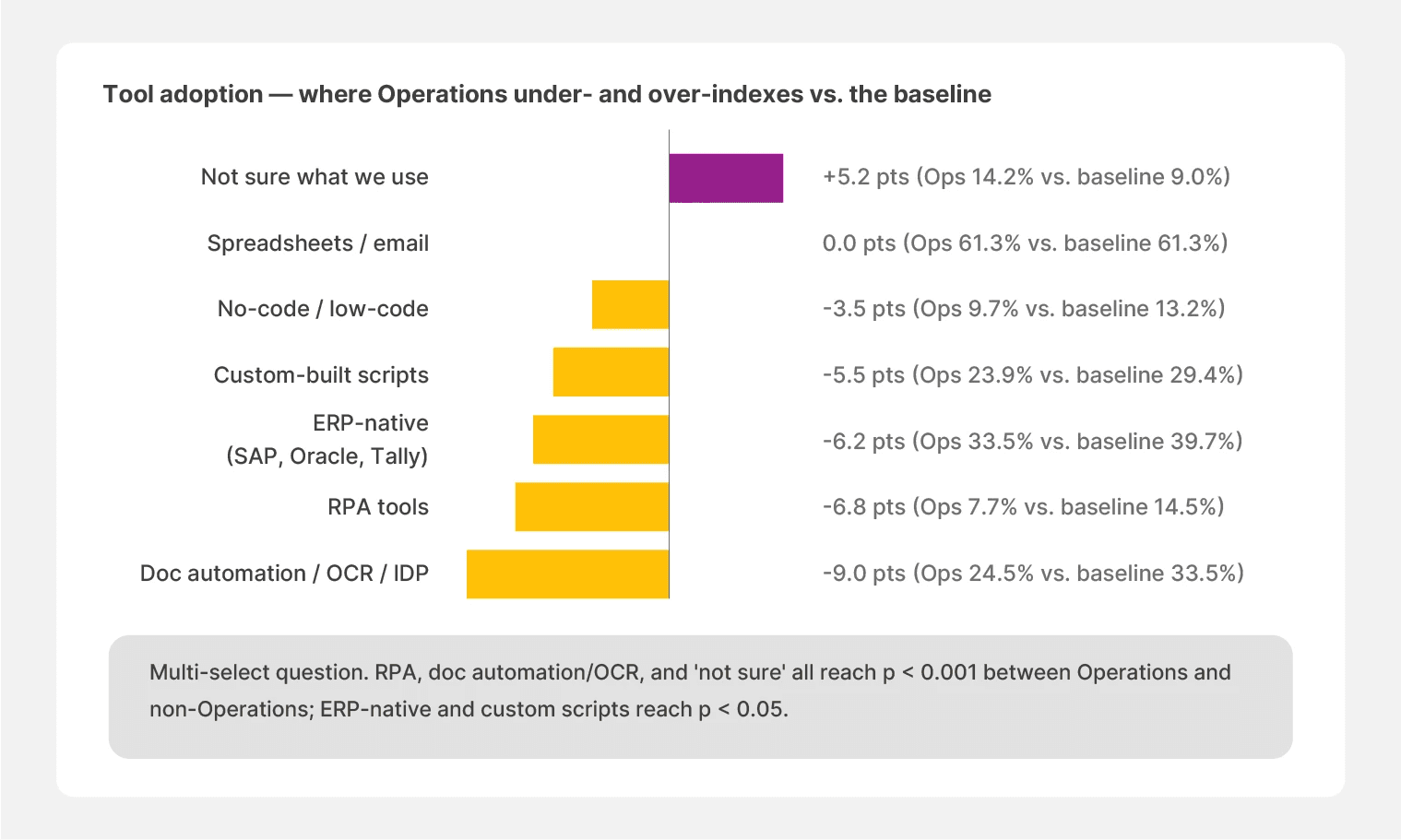
The tooling category most relevant for teams without dedicated IT is also the one Operations has adopted least. That is the tension at the heart of this whole section. No-code workflow builders are the model that lets the AP supervisor or dispatch lead change a routing rule without filing a ticket. For a function that often has no IT queue to route requests to, that should be the first place to look. The tools that would help most are not yet on the radar.
#5: 14.2% of Operations respondents don’t know what automation tools their team uses today
The same survey shows that 14.2% of Operations respondents aren’t sure what automation tools their team uses today. The figure in the survey overall runs at 9.0%. About 1 in 7 Ops teams can’t name what is running today, compared with 1 in 11 across the rest of the survey. That is the largest awareness gap of any segment in the data.
Without a dedicated IT person to ask, the tool stack grows quietly. The AP supervisor uses one workflow for invoice intake. The dispatcher uses another for BOLs. The warehouse lead has a third for receiving paperwork. Nobody has visibility across all three. When you start evaluating a new tool, the first question is not which vendor to pick, but what you are already running. A meaningful share of the cohort can’t answer that yet.
#6: 21.3% of Operations teams revert to full manual handling when automation breaks
Among Operations teams, 21.3% say their process falls back to fully manual handling when automation breaks. The baseline across the broader survey runs at 16.1%. Ops is about a third more likely to revert to manual than the average team in the data.
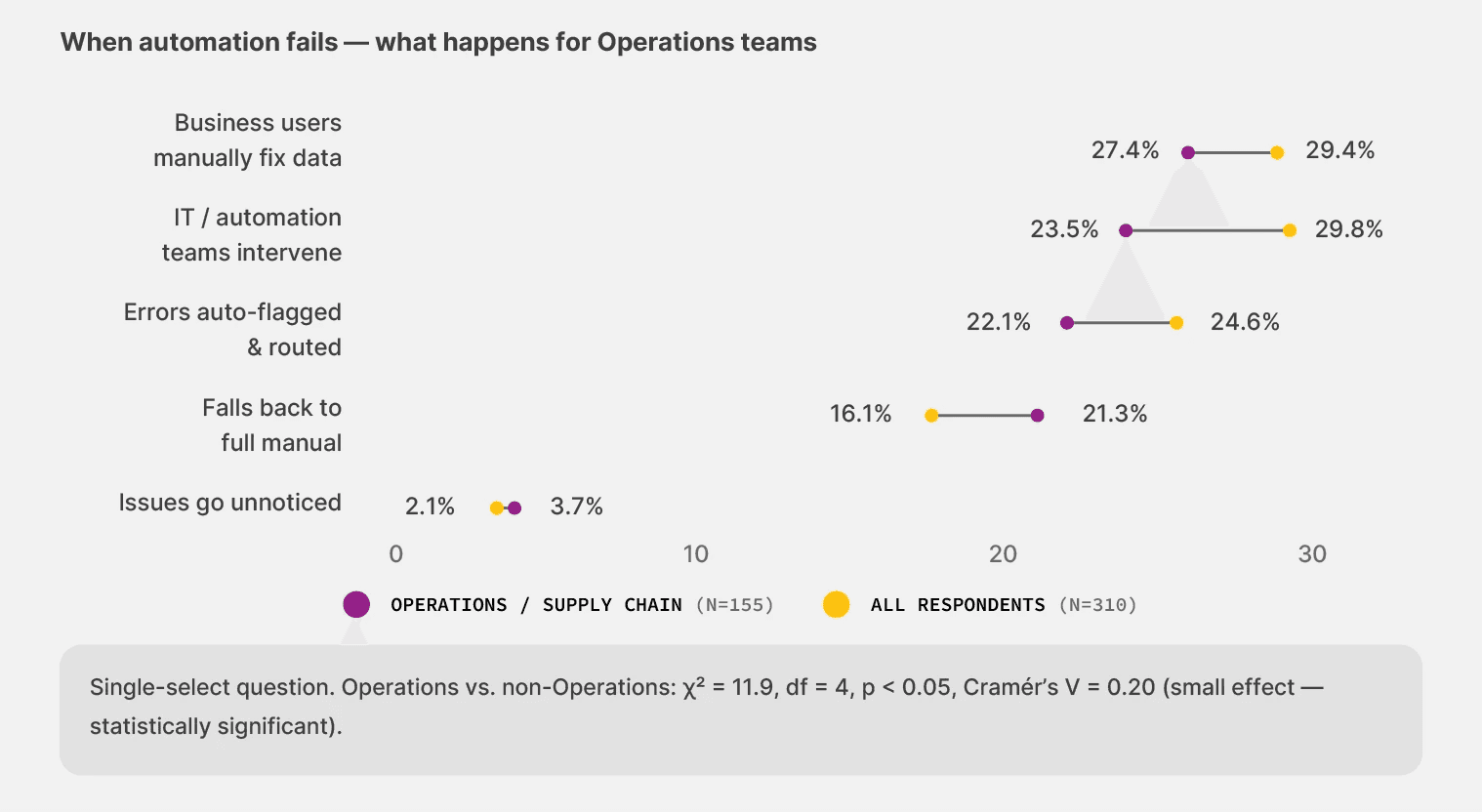
When extraction fails on a freight bill, the dock supervisor stays late and re-keys the BOL by hand because the carrier is waiting on the proof of delivery. There is no IT queue absorbing the work because there is often no IT to call. The cost shows up as overtime hours, not as a budget line, which is also why the cost is easy for the rest of the business to miss.
#7: 3.7% of Operations teams say document automation failures go completely unnoticed
Across the Operations cohort, 3.7% say document automation failures go completely unnoticed until they cause downstream damage. In our survey overall, that figure runs at 2.1%. That means silent failures hit Ops at almost double the rate of the average team.
Without monitoring infrastructure, Operations teams don’t see breakage until it surfaces as a missed shipment, a duplicate payment, or an HS code flag from customs. By the time the failure is visible, the cost has already compounded.
The pattern stacks on top of everything above it: low no-code adoption, low awareness of the current stack, and manual fallback when the workflow breaks. The result is a layer of the business where breakage stays invisible until it gets expensive.
Why Operations is the segment in the survey to most ready to move
The last few sections covered what's holding Operations back. But the same survey shows another side to these teams. They tend to see results quickly once they automate, and more of them are open to changing tools than any other group. The next three numbers explain why a segment this far behind is also the one most ready to move.
#8: 57.4% of Operations teams who automate see meaningful value within 60 days
When Operations teams do automate, they feel it fast. According to Docxster's 2026 survey, 29.4% see meaningful value in under a month, against 25.3% across the wider survey. Stretch the window to 60 days, and you’ve got more than half the cohort (57.4%) already seeing the payoff.

Why so fast? Because they started from nothing. Picture a team that has been re-keying freight bills by hand for years, line by line, every afternoon. The first time a tool does that work for them, the difference is not subtle. There is no legacy system to wrestle, no clever edge case eating the gains. The easy wins are all still sitting there, untouched, which is precisely what you would expect from a function that has been doing it the hard way.
#9: 23.2% of Operations teams are actively re-evaluating or replacing their existing tools
Nearly a quarter of Operations teams (23.2%) told us they’re actively looking to swap out or replace the tools they use today. No other segment in the survey is that restless. The wider average sits at 21.3%.
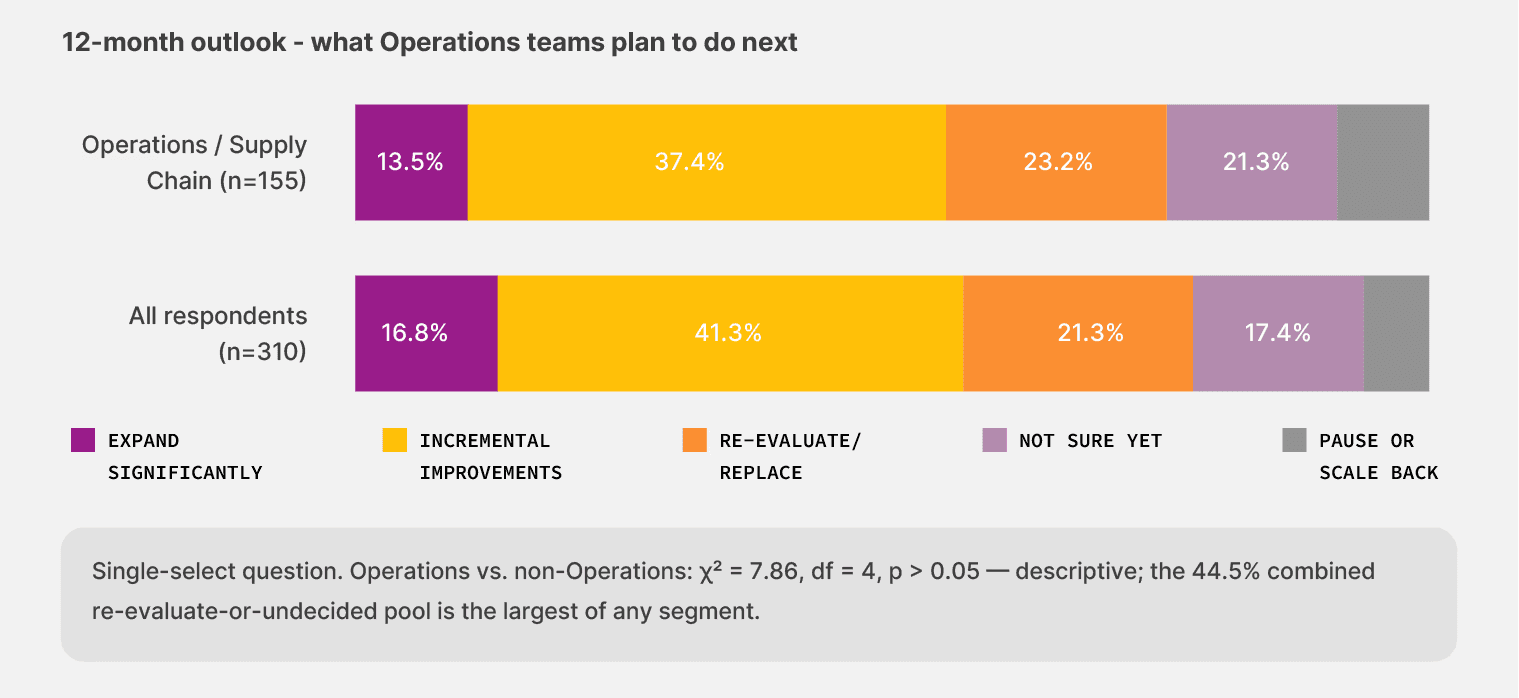
It makes sense when you think about it. A Finance team that sank a year and a real budget into ERP customization has every reason to protect that investment—switching costs them. Operations rarely has that anchor. They have felt the pain longer than anyone and have the least to lose by walking away from it, which is why the segment you would bet on to move slowest is the one leaning hardest toward the door.
#10: 44.5% of Operations teams could be swayed in the next 12 months
Put the deciders and the undecided together, and the number gets striking. The 23.2% actively shopping, plus another 21.3% who are not sure yet, add up to 44.5% of Operations teams open to a change in the next year. That is the biggest pool of persuadable buyers anywhere in the survey.
Here’s the part worth sitting with: most of those undecided teams aren’t stalling because they think automation is a waste. They’re stalling because they don’t yet know what they would even be choosing between. That’s a world away from "we don't see the ROI."
Notice how closely that 21.3% tracks the 14.2% who couldn’t name their own tools earlier in this piece. The hesitation isn’t about value, but about visibility. They aren’t asking whether to buy. They are asking how to judge the next tool when nobody was quite sure what the last one did.
Where do Operations teams go from here?
These ten numbers tell one story. Operations does the most document work, runs it on the least automation, and gets the least help when something goes wrong. But the same teams see results quickly once they automate, and more of them are ready to try something new than any other group in the survey.
What they want is straightforward: tools they can set up and change themselves, without waiting on IT.
The Operations segment report goes deeper on all ten stats, with the full charts and the data behind them. You can find it here:
State of No-Code Document Automation Report 2026: Operations Segment
FAQs: Document Automation for Statistics
What is document automation for Operations teams?
Document automation for Operations teams means using software to capture, extract, validate, and route information from documents like bills of lading, freight bills, customs forms, delivery notes, and purchase orders. It helps reduce manual re-keying and keeps shipments, receiving, billing, and compliance workflows moving faster.
Why do Operations teams need document automation?
Operations teams deal with high document volume and high document variety. A single shipment can involve several documents from different senders, each with a different format, which makes manual processing slow and error-prone.
How automated are Operations document workflows today?
73.5% of Operations teams describe their document workflows as partially automated or worse. That makes Operations the least automated segment in the survey.
How many Operations teams still process documents manually?
23.9% of Operations teams still describe their document workflows as fully manual. That means nearly one in four teams are still processing documents like BOLs, freight bills, and POs by hand from end to end.
What automation tools are Operations teams using?
Some Operations teams use document automation, OCR, or intelligent document processing tools, but adoption is still relatively low. 24.5% of Operations teams have adopted those tools, compared with 33.5% across the broader survey.
Why is document automation adoption lower in Operations?
Operations teams often have smaller IT support structures, fragmented tool stacks, and less visibility into what automation is already in place. 14.2% of Operations respondents do not know what automation tools their team uses today.
What happens when document automation breaks in Operations?
When automation breaks, Operations teams are more likely to fall back to fully manual handling. 21.3% of Operations teams revert to manual processing when automation fails, which can create overtime, delays, and hidden costs.
Why are silent automation failures a problem for Operations teams?
Silent failures are dangerous because they may not appear until they cause downstream damage. In Operations, that could mean a missed shipment, duplicate payment, customs issue, or delayed proof of delivery.
How quickly do Operations teams see value from automation?
Operations teams often see value quickly because many are starting from manual or brittle workflows. 57.4% of Operations teams that automate see meaningful value within 60 days.
Are Operations teams ready to switch automation tools?
Yes. 23.2% of Operations teams are actively re-evaluating or replacing their existing tools, and another 21.3% are unsure, meaning 44.5% could be open to change in the next 12 months.
Turn documents into decisions.
See how Docxster gets you from inbox to insight in minutes, not days. Bring your toughest workflow — we'll show you what it looks like solved.


